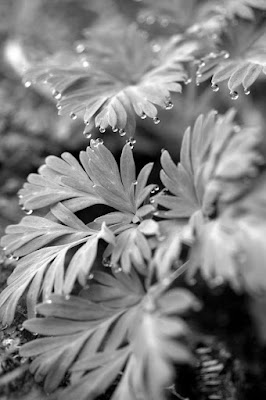
I thought I took tons and tons of wildflower pictures during Shoot the Hills, but in reality I took very few. Or maybe I should say: very few that were different from each other. I often stayed with the same flower for a long time, trying different angles and different exposure compensation. Unfortunately, I was not too thrilled with the composition on most of them, so that's something for me to work on in the future!
Some of you may be thinking, "Don't be so hard on yourself!" I don't see it as being hard on myself, but more as going through a learning process and knowing that I can get more from my images than I sometimes end up with. It's frustrating when you have an idea of what you want to capture, but you don't quite get it. What to do about it? Keep trying!
Anyway, enough babbling about what goes on in my head when I'm taking pictures. Here are some of the results!
A few technical notes on how I got such close shots of the flowers. While I dream of someday owning a true macro lens (as well as 300 or 400mm zoom lens, a fisheye lens... the list could go on and on!), I can tell you they are not cheap. Macro can be done slightly cheaper by getting diopter lenses, but even here there is an expensive option and a cheap option. (Here's a link to a helpful article spelling out the differences between the cheap and not as cheap.) Since the cheap option was SO cheap (less than $30 for a set of 3 close-up filters of 3 different strengths that can be used singly or stacked together), I figured "Hey, it can't hurt to try." And so I did. For the most part, I am happy with these little filters, but I am still getting used to what they can and can't do.
All of these close-up flower shots were taken with my 18-55mm lens with the +2 and +4 filters attached. Here's another little lens tidbit. I only just learned (like within the last month) that my 18-55mm lens (which is the widest angle lens I own) actually has a closer focusing distance to objects than my "telephoto" zoom lens (55-200mm). I've had this camera for 3 years, and I'm almost embarrassed to admit that I just learned this information. Before I learned this info, the telephoto lens was my favorite lens, but I was always frustrated by how far back I had to get from an object (over 12", I believe) before the camera/lens would get in focus. Not a plus for flower photography. Needless to say, I am very much looking forward to taking closer shots of flowers with my "shorter" lens and with the close-up filters attached.
My next post will be my 150th post - a bit of a milestone, I think. I want to share my waterfall shots from the Hocking Hills, which will wrap up my "report" on Shoot the Hills, but I'm also dying to tell you all about the deluge of migrating birds that have showed up on or near our property this weekend....! (My yard list for the month of April is over in the sidebar if you want to get an idea of what I'm talking about.) I think I need to toss a coin to decide!
Saturday, April 25, 2009
Hocking Hills wildflowers
Filed under:
Dutchman's Breeches,
Hepatica,
Hocking Hills region,
Squirrel Corn,
Trout Lily
Friday, April 24, 2009
Photos featured on All About Birds
While none of my photos won any prizes at the Shoot the Hills photo competition, I was just recently notified that two of my bird photos are being used on Cornell's All About Birds ID guide webpage!

This picture of a male Purple Finch can be found on the "front page", so to speak, of the Purple Finch's species account. If you scroll down to the section where it shows "Field Marks", you will see that there is a series of 10 different photos. My photo is the 7th one (you have to scroll sideways through the series to get to it).
Also, this picture of a female Purple Finch is found on the House Finch species account page, shown in the "Similar Species" category. The above photo of the male Purple Finch is also shown here.
I was very excited to learn that my photos had been selected, and I'm so appreciative to Cornell for using them!
To those of you who participate in Project Feederwatch or NestWatch, or any of the Lab's other Citizen Science programs, don't be shy to submit any photos that you take of your birds. And even if you don't participate in citizen science projects, you can still submit bird photos to Cornell via their Flickr group, called Birdshare.
This picture of a male Purple Finch can be found on the "front page", so to speak, of the Purple Finch's species account. If you scroll down to the section where it shows "Field Marks", you will see that there is a series of 10 different photos. My photo is the 7th one (you have to scroll sideways through the series to get to it).
I was very excited to learn that my photos had been selected, and I'm so appreciative to Cornell for using them!
To those of you who participate in Project Feederwatch or NestWatch, or any of the Lab's other Citizen Science programs, don't be shy to submit any photos that you take of your birds. And even if you don't participate in citizen science projects, you can still submit bird photos to Cornell via their Flickr group, called Birdshare.
Filed under:
All About Birds,
Cornell Lab of Ornithology,
purple finch
Thursday, April 23, 2009
Birds in the Hocking Hills
While I was taking photos during the Shoot the Hills photo competition this past weekend, I made sure that my ears were "on" so I could listen for birds. I was not disappointed.
I was absolutely delighted to hear my first Wood Thrush of the season (haven't heard any in our own woods yet), and I also heard my very first Hermit Thrush - EVER! Unfortunately I didn't see either of them, but their haunting, beautiful songs were rewarding enough. The Hermit Thrush should be preparing to head farther north to its breeding territory, whereas the Wood Thrush is just migrating into its breeding range from down south, so I imagine the window of time of being able to hear both of these thrushes on the same day is probably pretty small. How fortunate I was!
I also heard plenty of Phoebes, a Chipping Sparrow kept me in constant company at my campsite, and I was lucky to hear (but not see) the Black-Throated Green Warbler. One of the easier warblers to identify by ear, it has an easily recognizable song of "zoo-ZEE, zoo-zoo-ZEE!" I heard them all over the place, and was happy to be sharing space with them as they make their migratory way through to points farther north. Apparently there were also Blue-gray Gnatcatchers in the area, because several folks captured photos of them, but I didn't see any personally. (The Photographer's Choice winner was an wonderful photo of a Gnatcatcher perched on a blooming Redbud tree.)
One place in the area to stop for some good water bird photography is Lake Logan. The north end of the lake is quite the haven for Great Blue Herons, Great Egrets, Mute Swans and Canada Geese. I'm sure other birds like it there, too, but these were the most obvious species. I also heard lots of Red-winged Black Birds around, too, but did not spot any of them.
Here's a Great Egret coming in for an awkward-looking landing (please excuse the photo quality - shooting right into the sun here):
Here is a Mute Swan in the middle of flapping his (or her?) wings:
There was also a female Mute Swan on her nest:
... and in mid-preen:
Finally, I got a series of photos of a Great Blue Heron catching his dinner:
Afterward he had to shake it out and got his feathers all floofy:
Only to quickly return to his calm, cool and collected self:
Hocking Hills State Park naturalist Pat Quackenbush informed us that Double-Crested Cormorants and Red-throated Loons have also been spotted at the lake, passing through on migration.
Coming up... wildflowers of the Hocking Hills!
Filed under:
Great Blue Heron,
Great Egret,
Hocking Hills region,
Lake Logan,
Mute Swan,
Shoot the Hills,
water birds
Wednesday, April 22, 2009
Captive Raptors
Late Saturday afternoon, after the Shoot the Hills competition submission deadline had passed, a "Cameras 'n Critters" program was hosted by park naturalist Pat Quackenbush. It was a chance for all us shutterbugs to get up close and personal with some of the park's rehabilitating raptors and other creatures.
First we met "Ivan" the Great Horned Owl. He was quite a handsome fellow.

Notice how Ivan is all hunched over? This, in combination with the chirps he was making, signaled that he'd really had enough of us all and wanted to go back to his enclosure.
The next bird he brought out was a beautiful Red-shouldered Hawk. He's only been at the park for 3 or 4 months, and they haven't named him yet. Look at that wing and the puffed up crest on his head!

Unfortunately this hawk lost 1/3 of his left wing in an automobile collision. He will never be able to fly again. The same is true for Ivan the owl, who is also missing a portion of one of his wings.

Despite the missing bit of wing, he's still quite a majestic-looking bird. I suggested that they name him Cinnamon.

We also got to check out this American Toad. We usually run across one or two of these in our yard every summer.

This is a male Red-tailed Hawk that did not get brought out for our close inspection. They have a male and female together in the same enclosure, and I think they are hoping for some breeding activity.
More Hocking Hills photos to come, including water birds,waterfalls, and lots of spring wildflowers!
First we met "Ivan" the Great Horned Owl. He was quite a handsome fellow.
Notice how Ivan is all hunched over? This, in combination with the chirps he was making, signaled that he'd really had enough of us all and wanted to go back to his enclosure.
The next bird he brought out was a beautiful Red-shouldered Hawk. He's only been at the park for 3 or 4 months, and they haven't named him yet. Look at that wing and the puffed up crest on his head!
Unfortunately this hawk lost 1/3 of his left wing in an automobile collision. He will never be able to fly again. The same is true for Ivan the owl, who is also missing a portion of one of his wings.
Despite the missing bit of wing, he's still quite a majestic-looking bird. I suggested that they name him Cinnamon.
We also got to check out this American Toad. We usually run across one or two of these in our yard every summer.
This is a male Red-tailed Hawk that did not get brought out for our close inspection. They have a male and female together in the same enclosure, and I think they are hoping for some breeding activity.
More Hocking Hills photos to come, including water birds,waterfalls, and lots of spring wildflowers!
Filed under:
bird photos,
Hocking Hills region,
rehabiliting birds
Tuesday, April 21, 2009
Hills entries
This past weekend I had lots of fun up in the Hocking Hills. I took LOTS of pictures (over 400 for the competition, plus almost 175 more the next day at a fun wildlife photo shoot). Since it's a competition, you can only submit a limited number of photos, so that means I had to whittle my 400+ shots down to only 6. That part was NOT fun.
I'll start off by sharing the photos I submitted (click on any photo to be taken to a larger view in my Picasa web album):
You are not allowed to manipulate images in any way for this competition - the photos must be submitted as they were captured in your camera. For this reason there were a lot of photos I took that I knew would be better cropped down (like photos of waterfowl that I just couldn't get close enough to). Also, I feel that even some of my entries look a little better with a flip of the "monochrome" switch:
This, however, is my favorite photo taken during the entire competition. I played around with my camera settings a lot to get this coloring.
I submitted this photo to the "Photographer's Choice" category. This category was voted on by all of the participating photographers rather than the judges, so it was a peer-based category. Any guesses as to what the subject matter might be?
Unfortunately, I did not win any prizes for my submissions. Oh well. There were almost 200 folks competing this year, so I was up against lots of other super photographers. Maybe next year!
Tomorrow I will be sharing some VERY cool bird photos I captured after the competition was over.
Filed under:
fun photography,
photo competition,
Shoot the Hills
Saturday, April 18, 2009
Collage for the weekend
Subscribe to:
Posts (Atom)