Sunday, April 1, 2012

Mother Nature airs her dirty laundry

I've never been one for pulling pranks on April Fool's Day, and I'm not about to start now. However, after looking at some wildflower photos I took today, I couldn't resist sharing a few images that are joke-worthy all on their own.

One flower that is prolifically in bloom right now is Dutchman's Breeches. Unfortunately, these pendulous pairs of pantaloons can be tricky to photograph. Being white flowers, any imperfections show up very easily, so getting a nice "clean" set of of breeches is somewhat of a challenge. Some fun can be had with the bad shots, though. Due to the way the flowers dangle on the stalk, it's easy to infer the notion of laundry hanging out on the line.


For example, the dingy pair hanging off to the right looks like it was soaked in tea or coffee for a while, and just wouldn't quite come clean. Those stubborn stains!


I call this the "poopy diaper" shot. Shouldn't take too much of a stretch of the imagination to figure out why.

I didn't come away with too many shots of this flower that I particularly liked, but here's one shot where someone got the bleach right and all the pants are clean:

Happy April! Get out there and smell the dirty diapers wildflowers!

Monday, March 26, 2012

Springtime beauty

Spring has sprung in my little corner of the world, and how! Reports from around the state confirm that most flowers and trees are at least 2 weeks ahead of schedule (in terms of bloom time) due to the ridiculously mild winter we've had and also the early warming trend we've seen so far this spring. Tonight we are under a freeze warning, though, so I'm not sure what our heavily flowered landscape will look like upon awakening in the morning.

Luckily I was able to get out on our property and some neighboring property over the weekend to get photos of just a few of the things that are in bloom. Enjoy!

Bluebells in my garden. This is the first year they have bloomed, even though I planted them 2 years ago.


Newly emerged Bluebell flower buds, kissed by a dew drop.


Bluets, a dainty but cheery flower.


How could you not be cheered by a flower that has a sunshine burst in the middle?


Bloodroot, which is normally just starting to bloom, is already starting to fade, with many plants already gone to fruit. This one is tattered and worn, but still beautiful.


When out looking at nature, you never know what you'll come across. Here, a pair of snail shells, the larger being about the size of a dime (if that), the tiny one being barely larger than a pin head. Always keep your eyes peeled for magical treasures!

Monday, March 12, 2012

When the Grackles descended

A few weekends ago I started to see Common Grackles in large numbers in a few spots in this corner of southeast Ohio. Around this time I also started to see Red-winged Blackbirds reliably. American Woodcocks have been doing their display flights since the beginning of February. With each passing day, the bird song becomes more melodic and beautiful, ushering in spring in such a magnificent way. And every few days, I come across a new sighting for the season - Eastern Phoebes and Wood Ducks are now seemingly everywhere, and I saw my first Field Sparrow of the season yesterday. Spring is on the wing!

Following is an account of one of my grackle encounters, which I posted to the Ohio-Birds listserv (one of several "virtual" online birding communities for Ohio birders). Enjoy!
Greetings, Ohio birders! This weekend has been a bit of a Grackle-fest for
me here in Athens County! It started when I was leaving work on Friday,
when a flock of approximately 50 birds landed in a couple of trees in a
residential neighborhood in Athens. I heard at least one Red-winged
Blackbird singing among the group, so I assume it was a mixed flock. That
was the first large gathering of Grackles that I had seen so far this year.

Turns out that was nothing compared to what I would experience yesterday and
today. A group of several hundred birds caught my attention yesterday
afternoon (Saturday) when I was out filling bird feeders at my home in rural
Athens County (Albany). I could hear a rustling noise off in the distance,
quite a ways across the road actually, and even though it was windy, I knew
there was no way it was leaves blowing in the breeze. After a few squeaky
gate sounds reached my ears, it dawned on me that there was a large pack of
Grackles in the neighborhood. They were too far away for me to get any good
views even with my binoculars, but I could make out movement well enough to
estimate that there were probably 100-200 birds in the flock.

This morning, a similar event happened on the hillside right next to our
property, and I was able to observe the birds much better. Again, it was
several hundred Grackles, probably about 300 of them, with at least a few
Red-winged Blackbirds mixed in, but I was never able to spot one of them - I
could only hear them. I'm guessing they were on the outer edges of the
group? I felt very lucky to have them so close and to be able observe them
so well. They spent a large amount of their time rooting through the leaf
litter, stirring up whatever insects they could find. The noise was quite
amazing: we all know what it sounds like when one person walks through the
woods in fall or spring, kicking up dried leaves as they go - well, imagine
that you and 50 friends are doing that all at the same time, and that's what
these Grackles sounded like. Every once in a while they would all take off
from the ground together, making a fantastic whooshing sound with their
collective wings, and then land mere feet away from where they had just
been, only to begin the whole rooting in the leaf litter process again.

They were, of course, calling and vocalizing to each other during all of
this, but it wasn't until they ascended into the trees that they became
really loud. They were on our property by this time, and as I looked
through the trees with my binoculars, I could see that many of them were
preening. So it seems they had a quick breakfast, and then were off to hit
the showers, so to speak, and making plans for the day. At least I imagine
that was what all the raucous conversation was about.

I uploaded a short video to YouTube that tries to communicate the din
surrounding me. Even though you can't see the birds (my iPod Touch doesn't
take great video), you can at least hear them pretty well.

Good birding!
Heather Aubke
Albany, OH

Saturday, March 3, 2012

Today I saw: American Kestrel

For a while I've been kicking around in my mind the idea of doing some serial-style posts that detail bird sightings and observations that I think you, my dear readers, might find interesting. Think of it as a "birders notebook" type of entry. I have shied away from the idea partly because there will invariably be birds that I do not have photos of from my own personal collection, meaning I will have to rely on online sources where I can get free images that are allowed to be used for public/educational distribution. Why? Because no one wants to read a post where there are NO pictures, but I will not just "lift" photos willy-nilly from web pages just to get images for a blog post. So we'll see how this goes. This will be my first installment of "Today I saw..."

Kestrel image provided by Clipart ETC, originally published in 1869 in Louis Figuier's Reptiles and Birds.

Today I saw an American Kestrel. It was perched on a phone wire along a mildly traveled county road, looking out into a corn field, prime habitat for this falcon. At first glance I wasn't sure that it was a kestrel because it was not doing its characteristic tail bobbing, a behavior that is a "gimme" for quick field identification. Luckily, there was a spot just up the road where I could safely pull off, and I was able to hop out with my binoculars and work my way toward the bird. Not having had a ton of experience with kestrels, I wanted to get a better look at it, just to be sure about the ID. My curiosity was well-rewarded.

As I approached I noticed another bird on the wire, which was a Rock Pigeon, and the still-in-question kestrel was quite a bit smaller than the pigeon. American Kestrels (also known as "Sparrow Hawks") are the smallest falcon in North America, so it was good to see this size comparison in person. For reference, Rock Pigeons are about 12"-14" long, whereas American Kestrels are about 9"-12" long. As far as field marks go, the lighting was not great, so it was a bit difficult to see any field marks well, but I was able to pick up barring in the wings and some vertical striping on the head, so I was pretty confident by this time that I was looking at a kestrel, even though it never bobbed its tail once while I saw it on that wire.

A cold, biting breeze was blowing, so it was time to head back to the car. Just a few feet from my car I took another look out into the field, and saw a dove-like figure flying over the field, except it wasn't behaving in a dove-like fashion. This bird was obviously hunting, so I knew I was seeing the kestrel. I quickly forgot about the chilly breeze and enjoyed the show this small raptor was putting on. It was hovering with shallow but fluid wing beats, and at times it was able to catch the breeze just right and simply hang in the air for 5 seconds at a time. When not hovering, it would fly in a roughly circular pattern over the area it was hunting, and I was finally able to pick up the rusty coloring of its back and tail. Such a slim, graceful bird it was. It dove to the ground twice, but both times it come up empty-taloned. Here's an interesting factoid that I gleaned from the Cornell Lab of Ornithology's All About Birds site:
Unlike humans, birds can see ultraviolet light. This enables kestrels to make out the trails of urine that voles, a common prey mammal, leave as they run along the ground. Like neon diner signs, these bright paths may highlight the way to a meal—as has been observed in the Eurasian Kestrel, a close relative.
It then took off to another portion of the field, and maybe eventually made its way back to the perch on the phone wire where I had originally spotted it. I was glad I took the time to stop and watch this bird. The observations gave me a good field experience that adds to my growing mental library of bird behavior, and gave me a good opportunity to share this bird with you.

Sunday, February 26, 2012

A certain stillness

Last weekend was the Great Backyard Bird Count, which normally has me planning to go to different locations to count birds. That was indeed my original plan, but life had other ideas. Last Saturday morning I awoke to a sick dog, and unfortunately he did not get better as the day progressed. A time that we had been anticipating and dreading had finally come. It's hard to believe that it's been a week since we had our poor, sweet Emmett put to sleep.

Our house is now feeling a bit empty. Emmett was the last of a host of pets that Dave and I have had the pleasure of knowing over the last 11 years. At 15-1/2, he was the oldest of them all. His sister, Jupiter, passed away a little over 2 years ago, just shy of her 13th birthday.

Amid all the bird songs that I hear daily now that are a sure promise of spring, a certain stillness hangs in the air. It's hard to adjust to not having a wagging tail and happy puppy to greet us when we get home from work. But instead of focusing on the things that are difficult, let me share some happier memories with you, memories of both Emmett and Jupiter.

I didn't know them as puppies, unfortunately - they were already full-grown by the time Dave and I started dating. I met them both the first time I came to Dave's place, and they were both very accepting of me, which was something that I felt was important if Dave and I were going to be a couple. I was especially grateful that Jupiter, the "other" girl in his life, took a liking to me.

They were both very cute adults, but as puppies... well, it was just ridiculous.

Emmett was quite a little ball of fluff. It took him a little while to grow into his face and his ears, though.


Emmett in his "adolescence."


And Jupiter in hers.


They loved to chase each other and play. I can't tell who's chasing who here, but I can hear them going "nyyeeeaaawwwwwrrr," round and round in circles!


They also liked to bite on each other, especially Jupiter on Emmett. This is when they were wee pups...


... and as adults. It's a move Jupiter would repeat over...


... and over. Eventually, many years into adulthood, Emmett finally developed a strategy to shake her off when she chomped on him like this, and it was a move that I called the "butt block." Actually, it was more of a hip block, where he'd ram his hip into her to get her off of him, but "butt block" sounds way more fun.


This isn't to say that he didn't get his own chomps in on her, though!

Their exact lineage is unknown, but "husky mix" was the breed reference we always gave. Having husky blood meant they liked to roam, often quite far from home. They always came back, but Dave and Jupiter one day learned the hard way that some folks don't take kindly to having strange dogs on their property. Jupiter got shot in her rear left leg, and fragments of the bullet stayed with her until the end. Living on 8 acres in the country made containing the dogs a challenge, to say the least. A radio fence was employed after the shooting incident, but both Emmett and Jupiter were masters at finding ways to get through the field of the fence, and they were always testing it, waiting for those times when a rodent chew or a deer run-through caused a break in the line, leaving the whole system down.

The day Dave asked me to marry him, the dogs "broke out" and came over into the field where we were (across the road from the house) to congratulate us. They didn't want to be left out! This was one time that we didn't mind that they were naughty dogs who disobeyed the rules.

Overall, they were good dogs. For as long as I knew them, they were outside dogs 90% of the time (with plenty of shelter available when they needed it, of course), and they seemed very content being that way.
They both loved the snow...

... and they both loved a good leaf pile.


And we loved them both very, very much. Two weeks before Emmett reached his end, I was able to get some nice photos of him. When I look at this photo now, it still tugs at my heart strings, but it also makes me smile. It captures his essence very well.

We miss you, dear friend. Rest in peace.

Sunday, February 12, 2012

Oh, how I love my birds

In my last post, I mentioned how Carolina Wrens are the apple of my eye as far as species that dine at my feeders in winter go(or any time of year, really). If a weekend of counting for Project FeederWatch goes by with a goose egg on my list next to "CAWR"* (the 4-letter shorthand, known as bander's code or alpha code, for CArolina WRen), it makes me sad. I worry.

This weekend I was sitting at the dining room table having a late breakfast, and I wondered out loud if "my" wrens were okay, because I had not yet heard a peep from them or seen them. Oftentimes they are one of the first birds I hear in the morning, so that was why I was a little concerned. Not to worry, though. As soon I finished posing the question to my bowl of cereal, up popped a wren onto the railing and right into the bowl that holds the bird dough.

It's when things like this happen that I can't help but wonder if there is some kind of connection between myself and the birds. I mean, come on! Wonder about the bird and then it shows up immediately thereafter, as if conjured?!

Don't worry, Heather - we are here and we are fine. Now, if you don't mind, I'm just going to sit in the food.

There were actually 2 of them sitting in here at one point, but I wasn't fast enough with the camera to get a shot of that. In total, there were 3 Carolina Wrens at my feeders at one time this weekend, as was the case last weekend. I had 3 of them at one time in early December, too. This is remarkable because this is the first year in 7 years of counting for FeederWatch that I've ever seen 3 Carolina Wrens at once at my feeders.

Contemplating his/her next bite?

I also enjoy the woodpeckers, and we get three species of them reliably: Downy, Hairy, and Red-bellied. The Downies seem to be the most tame of the three, readily coming in to the suet feeders even if I'm standing right next to them. This sweet little female Downy Woodpecker looks like she just landed, what with the little spray of snow under her tail.

Tra-la-la, minding her own business, making sure I'm getting her good side...

... then this feisty fella shows up. Doesn't he look MAD?! His little head feathers are all puffed up, full of 'tude.

Here's a look at his puffed up mane from the back:

And even though he's chased the female away by now, his bravado continues:

Oh wait, never mind. It's all cool. No problems here, lady.

Lemme jus' grab a big ol' hunk o' dough...
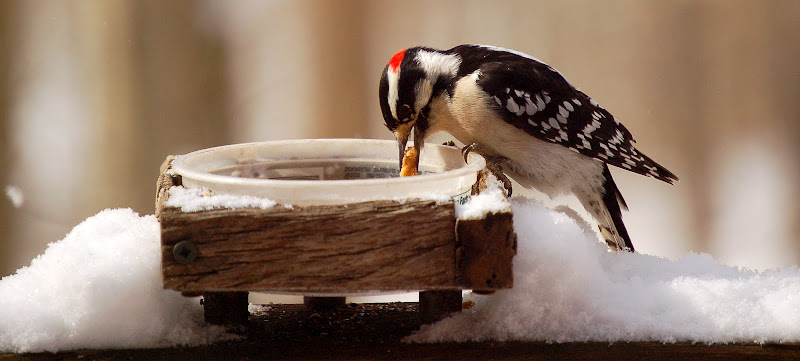
And get on outta here!

I soooo love this shot, caught serendipitously by depressing the shutter at just the right time, of course. It almost has the feel of a raptor caught in flight rather than a woodpecker.

Yes, friends, these are just a few examples of why I love my birds. They are wonderful in every way.

*Okay, regarding the alpha code for Carolina Wren... CAWR isn't technically correct, because that abbreviation could also refer to 2 other wren species in the United States: CActus WRen and CAnyon WRen. The correct bander's code for each of these species is as follows: CACW (Cactus Wren), CARW (Carolina), and CANW (Canyon). I use CAWR for my wren, though, because the chances of me encountering either of the other 2 species, which live out west, is pretty remote at my feeders. Besides, it's shorthand that's supposed to be easy for ME to read. But I digress.