Showing posts with label bird photography weekly. Show all posts

Monday, September 7, 2009

My aha! moment with a Yellow-bellied Sapsucker (BPW)

While we were vacationing up in northern Michigan earlier this summer, I got to add a bird to my life list: the Yellow-bellied Sapsucker. I was pretty psyched about it. Before I saw the bird, I noticed its calling card:


Sap holes!

According to the All About Birds page for Yellow-bellieds, they drill 2 kinds of holes: deep round holes into which they insert their bill to extract sap, and shallow rectangular holes which must be constantly maintained in order for the sap to keep flowing.

Their preferred nesting habitat is aspen and birch trees, both of which surround the house.


"Blending in"


I observed several individuals, but had a hard time pinning down sex and age. The one in the middle seems to be a male (ID'd by the red on the throat), but the others could be female, or juveniles. I did see some juveniles being fed by a parent, but didn't get any photos of that. Leaves on the trees and poor lighting kept me from getting excellent views of them, even with binoculars.

One thing I was able to see pretty clearly, though, when the light shone on the tree just right, was the abundance of bugs that were attracted to the sap flowing from those holes. A little while later, I had my aha! moment:


Bugs attracted by sap means food for the birds! Not rocket science, I know, but I don't think I would have necessarily made the connection if I had not seen it with my own eyes. Just goes to show how powerful of a learning (and remembering) tool personal observation can be.

Want to see more bird photos? Head on over to Birdfreak's blog for this week's edition of Bird Photography Weekly by clicking on the badge below. You'll be glad you did!

Sunday, August 2, 2009

Roadside birding (BPW)

The subject matter is a little out of date (these photos were taken in early June), but I would still like to share them. Besides, they may be a welcome sight since breeding season is winding down for most birds. Perhaps we can use it as a reminder of those days of spring and early summer when territory and breeding displays were in full swing and the dawn chorus was going strong...

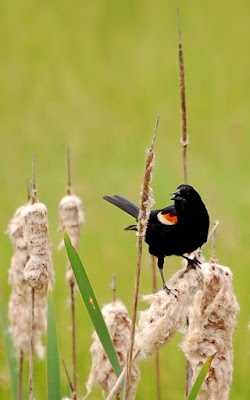
There is large, grassy field edged with cattails that I pass every day on my way to work. In early spring, I eagerly await seeing the male Red-winged Blackbirds that perch on the cattails, small trees, and even the stop signs along that stretch of road. Early in the season many of them congregate rather close to each other, sometimes even sharing the same tree. But once breeding season is under way, only one male (MAYBE two) will claim that field as his territory.


Displaying and singing

I have read that the male Red-winged Blackbirds, just like male Bobolinks, are polygynous (one male mates with many females). Here are a few members of this male's harem, barely visible through the tall grasses:


Click any photo to enlarge

There was a lot of chatter going on among these birds the day I took these photos. Not only was the male singing, but the females were extremely vocal as well. As I watched their movements out in the field, I began to wonder if they had active nests that they were guarding. My question was soon answered when I saw both the females and the male bringing in food for new baby blackbirds...


I was not able to determine where their nests were actually located, as both the male and female birds were very wary of my presence and were determined not to give away their nest location(s).

Here are some interesting facts about the Red-Winged Blackbird:
  • The male spends at least a quarter of his time during daylight hours defending his territory against other males and nest predators.
  • The oldest recorded Red-winged Blackbird was 15 years 9 months old.
  • Red-winged Blackbirds throughout most of the U.S. migrate only very short distances, if at all.
(info courtesy of All About Birds)

Sunday, June 14, 2009

Eastern Phoebe perching (BPW)

Way back at the beginning of spring I posted some pictures and videos of the Eastern Phoebe nest that we have on the side of our house. I was remiss in that I did not post many updates about the nest's progress. I am happy to report that 5 (presumably) healthy babies fledged from that nest. And now, our Phoebe pair is in the midst of rearing their second brood, once again of 5 nestlings.


Phoebes might be one of the easier birds to photograph because they tend to perch for long periods of time in one spot. And, if you're lucky to have them nesting on your house, you will soon learn their favorite perching spots that are on the path to and from the nest.

Unfortunately, it has becoming increasingly difficult for me to get decent photos of these birds now that the trees are fully leafed out. Our woods are very dense and filled with shadows, so I have to wait for them to come out to a perch that is in more direct light. They have become very fond of sitting on various shepherd's hooks in the garden, and on a spud bar that is standing up in our driveway, which is where this handsome bird is perched.


Here are some videos we captured of the previous brood.

This first video is of the 5 very large fledglings trying to rearrange themselves in the nest. I call it playing musical chairs. It's quite a precarious venture to move around in there!


This is the video of 3 of the 5 fledging from the nest (1 had already fledged previous to this video). One lone baby remains at the end, too scared to make the leap with everyone else! It seems baby #5 departed within 30 minutes of his other nest mates.


I do worry that once this second brood has flown the coop that we won't hear or see much of the whole family for the rest of the season, which will be a sad thing. I hope they come back and visit from time to time.

This post was for Bird Photography Weekly #42. For more Bird Photography Weekly, go here:

Sunday, March 1, 2009

Uncommon Beauty


Mourning Dove - Zenaida macroura

The Mourning Dove is one of the most common birds seen across the United States (coming in second to the Northern Cardinal according to this year's Great Backyard Bird Count).

I think many might agree that the word "common", when applied to the Mourning Dove, fits the bird in multiple ways:
  • Widespread; prevalent
  • Not distinguished by superior or noteworthy characteristics; average
  • Of no special quality; standard
  • Unrefined or coarse in manner; vulgar
I would have to challenge all of those assumptions about the commonness of the Mourning Dove, though. Have you ever stopped to really look at one? They are quite lovely. There is nothing common about their beauty.


Mourning Doves, fluffed out during preening


In the midst of preening


Being polite and keeping its feet OUT of the food supply...


Zoomed in on the plumage (this would have been a good Plume Zoom subject!)


Ice/snow accumulation on tail


Such ice/snow accumulation can cause Mourning Dove tail feathers to be pulled out if they get stuck to a branch (thanks to Julie Zickefoose for this information and feather ID).


Unfortunately, I can't do much to defend that last definition of "common" when applied to the Dove ("Unrefined or coarse in manner; vulgar"). I mean, c'mon, a bird that poops that much and leaves his poop right in among the seed and the bird bath? There's no defending that. Good thing they're pretty...!

This is my first submission to Bird Photography Weekly, hosted every Monday over on Birdfreak's site. Go check it out and see who else is showing off their birds.

By the way, what bird do YOU find to be beautiful?