Showing posts with label birding by ear. Show all posts

Sunday, January 8, 2012

Putting birding skills to use

One of the most rewarding aspects of birding for me is being able to put something that I recently learned to use by making new discoveries of my own based on that learning.  I had one such experience today.

I was walking along our rural road, enjoying the sunshine and abnormally warm temperatures for January.  I stopped often to look and listen for birds.  One particular area caught my interest for some reason, maybe because I don't normally pay much attention to this particular spot, or maybe I caught some special birdie vibes.  I saw movement in the grass, heard some Song Sparrows and saw some other sparrows that I couldn't make out well enough to positively identify.  Then I heard a chip note that caught my ear.  At first I thought it was an Eastern Phoebe, which would have been a really cool find for this time of year.  Once I got my binoculars on the culprit, though, I realized it was a Swamp Sparrow.  I was especially excited about this because this was a new find for me along our road.

What was more intriguing to me, though, was the fact that I had been tricked by this Phoebe-sounding chip note just about a week ago while doing the Hocking Hills Christmas Bird Count (CBC).  My neighborhood habitat is very similar to that of our CBC Swamp Sparrow habitat: close to a creek, with lots of overgrown grasses in a low-lying area that's known to get wet (and stay wet) after too much rain, and with moderate but spotty tree density.  When we first heard the "chip!" during the count, our group leader, Jim McCormac, thought it was a Phoebe.  The closer we got to the source, though, the less convinced we were that it was actually a Phoebe.  It eventually dawned on Jim that it was more likely to be a Swamp Sparrow.  While we never actually saw the bird in question that day, after comparing recordings of a Phoebe "chip" to that of a Swamp Sparrow "chip," all 3 of us agreed that what we were hearing was a Swamp Sparrow.


Swamp Sparrow in winter plumage. Photo by Kevin Bearcaw, via Wikipedia

Sure enough, I was being confronted with the same situation on my home turf.  Only this time I got to see the bird.  I even went so far as to walk back home and get my spotting scope so that I could get a really good grasp of what this bird looked like.  To look at it, it seems like not a very exciting bird, unless you like trying to categorize different hues of brown, rust and grey.  I have to admit that I would be hard pressed to identify this bird by looks alone simply because I haven't seen very many of them.  (I can tell you a Song Sparrow from a White-throated from a White-crowned from a House, but that's about the extent of my ability to ID sparrows on sight.  They don't get the nickname "Little Brown Jobs" (or LBJs) for nothing!)

Swamp Sparrows winter in southern Ohio, but it seems few stick around these parts for breeding season.  Preliminary data from the recently completed 2nd Ohio Breeding Bird Atlas (2006-2011) show, however, a handful of confirmed breeding locations in the southern 3rd of the state.  This is in stark contrast to the last Ohio Breeding Bird Atlas (1982-1987), which shows possible and confirmed nesting only in the northern 2/3's of the state.  Having now seen (and heard) this bird in my own neighborhood during winter, I will now be keeping a watchful eye out for a possible breeding record this coming summer.  Now THAT would be exciting!

Thursday, January 5, 2012

Hocking Hills Christmas Bird Count

Snow-flocked Hemlocks in the Hocking Hills
January 2nd turned out to be a cold, brisk, wintry day, perhaps not the best of days to be out birding.  The roads went from dry to snow-covered in a matter of hours, and we found ourselves in near white-out conditions at a few points in the day.  As a result, the birds stayed hunkered down for the most part, except for a few pockets of activity here and there.  I had hoped for at least 40 species for the day, and we ended the day with 44 species; however, only 35 of those were in our count territory - the other 9 were "borrowed" from Lake Logan, which was the territory of another count group.
I'm glad we stopped at the lake first thing, though, because there was much waterfowl to be seen.  Due to the mild weather that we've had thus far, the water was completely open (i.e. not frozen), so there were many more waterbirds than one would find if the lake had been even partially frozen.  We saw several good-sized rafts of American Coots and Hooded Mergansers (with females greatly outnumbering males), a couple of Pied-billed Grebes, a Double-crested Cormorant, and a Horned Grebe.  Please let it be noted that, with the exception of the Coots (and maybe the Mergs), I probably wouldn't have been able to ID the other waterfowl due to utter lack of experience (especially since they're all in basic, or non-breeding, plumage right now!).  Thanks to our fearless leader, Jim McCormac, for pointing out all these great birds!

As strange as it may sound to some, I find an odd type of enjoyment in driving around and stopping and looking and listening for birds.  Of course, this is all done on rural roads, so traffic is not too much of an issue, but you do have to be mindful of private property.  We stopped and "staked out" a couple of yards with feeders, and if the homeowners would have happened to look out while this car full of people with binoculars was checking out their house, they might have been a little alarmed!  One of these feeders got us our only House Finch of the day, though.

My bird count partners, Olivia and Jim.
Some species came easily, and were spotted or heard at almost every stop, with the American Crow probably taking the prize there.  Dark-eyed Juncos were also observed in great numbers (101 for the day for our group, I believe).  Other species like Carolina Chickadee and Tufted Titmouse were observed in surprisingly low numbers, especially given the number of forested habitats we encountered.  We got all 5 woodpecker species that we expected (Downy, Hairy, Red-belied, Northern Flicker, and Pileated), but we had to work really hard for the Hairy, and all the Pileateds were silent fly-bys.  That's one woodpecker you tend to hear more than you see it, but not on this day.  We had 4 Belted Kingfishers for the day, which I thought was a high number, but very few Starlings or House Sparrows, both of which I would have expected to see in decent numbers simply due to their commonness.

Surprises for the day came both in the form of what we saw and didn't see.  The aforementioned Horned Grebe was a nice find, as were several hearty-souled Savannah Sparrows cavorting with a large flock of Juncos, a Bald Eagle soaring over Lake Logan, and a few Killdeer holding out on the mudflats at the lake.  We had several misses, too, that were disappointing: no Turkey Vultures (did see a number of Black Vultures, though), no Red-tailed Hawk, and no American Kestrel.  Regarding the latter two, I suspect our chances would have been better if the weather weren't so dreadful.  Who wants to be teed up in a tree or perched on autility line when the wind is blowing the snow sideways?  We had also hoped and tried for Red-breasted Nuthatch, Winter Wren and maybe an overwintering Eastern Phoebe, but no luck.  And so it goes.

The day wrapped up at Crane Hollow Nature Preserve, where we had a group gathering and pot luck.  It was nice to sit in this warm, cozy house with some yummy snacks and in the company of friends, new and old, while we compiled the day's findings.  It was a wonderful way to start the new year!

Here's the full list of species that our group saw and/or heard, if anyone cares to know:
  • Hooded Merganser
  • Double-crested Cormorant (new for the Hocking Hills count!)
  • American Coot
  • Canada Goose
  • Pied-billed Grebe
  • Horned Grebe
  • Mute Swan
  • Mallard
  • Killdeer
  • Belted Kingfisher
  • Bald Eagle
  • Red-shouldered Hawk
  • Northern Harrier
  • American Crow
  • Norther Cardinal
  • Blue Jay
  • Carolina Chickadee
  • Tufted Titmouse
  • White-breasted Nuthatch
  • Brown Creeper
  • Song Sparrow
  • White-throated Sparrow
  • Dark-eyed Junco
  • Savannah Sparrow
  • Swamp Sparrow
  • American Tree Sparrow
  • Eastern Towhee
  • Hermit Thrush
  • Eastern Bluebird
  • American Robin
  • Pileated Woodpecker
  • Downy Woodpecker
  • Hairy Woodpecker
  • Red-breasted Woodpecker
  • Northern Flicker
  • Mourning Dove
  • American Goldfinch
  • House Finch
  • Carolina Wren
  • Golden-crowned Kinglet
  • Black Vulture
  • Northern Mockingbird
  • House Sparrow
  • European Starling

Wednesday, July 28, 2010

Thoughts on the season

I never know where a walk is going to take me. Oh sure, I know physically where I am going - there's always a destination in mind. What I'm referring to is where I go in my head, and in my heart, on some walks. Often I set out on a photo walk only to absorb much more than what I went out to photograph.


Tall Ironweed

I experienced just such a walk this evening, and found myself contemplating the season. It's bloody hot, for one thing. By 7pm there was still not much respite from the heat and humidity, and the air was heavy. It wasn't just the humidity, though. There was a subtle hum on our country road, barely audible, but heard easily enough upon standing still: bees. Way up in the trees, and down at the flowers. I didn't see many of them, but their buzzing hung like a blanket in the air indicating a massive presence. The occasional horse fly also hummed by here and there. Within a few hours, once it is dark out, the cicadas and crickets will start singing their melodies. All of them sounds of industry in the insect world - sounds associated with getting food - or getting busy.


Common Milkweed

Even though the temperatures soar each day, it is not lost on me that the days grow shorter now, and that I must race out after dinner if I want to photograph in certain areas before the hills occlude the golden light of the setting sun. There seems to be a certain sense of busyness permeating the landscape, an urgency. Although it is not yet August, some birds are already working on putting on the body fat that they will need to sustain them through fall migration. It makes sense to me now why all these big juicy bugs and ripe fruits and nuts come out in abundance at this time of year - because they are needed, because they will prepare bodies for long travels or hibernation or for a time when the proverbial table is almost bare.


Spotted Knapweed

I took a good listen to the birds on tonight's walk, and was surprised to still hear so many birds singing despite the fact that breeding season is over for most of them. Scarlet and Summer Tanagers, Yellow-billed Cuckoo, Eastern Towhee, Blue-grey Gnatcatcher, White-eyed Vireo - all easily discernible from their perches in and at the edges of the woods. I watched a family of Gnatcatchers gleaning insects from tree leaves, wishing I had my binoculars with me to see the young ones better. Out in the mowed field I could just barely make out an Eastern Bluebird singing, soft yet bubbly. Their burst of blue coloring will be a welcome sight when I come across them in winter - nothing like a bluebird contrasted against a field of snow to cheer you up.


Tall Ironweed catches the evening sun

When I set out on my walk, I walked briskly and with purpose to a few spots where I had spied certain flowers of interest from the car during my daily commute. The return walk was much more leisurely and casual, which allowed my mind to wander. I contemplated how our meteorological seasons seem to be much more attuned to the true "feel" of the seasons than do the solstices and equinoxes dictated by the astrological seasons. I thought about how even though there is a sense of urgency in the air, there is also a feeling of tiredness - as if the flowers, for example, are straining to give everything they've got to put out fruit before the it's too late and the strain is just wearing them out. I'm sure, however, that's just me forcing my own perceptions of tiredness of these hot days onto the landscape.

As I made my way up the driveway and started thinking about various projects that I need to get done, it dawned on me that my walk had taken my mind off the stuff of the every day. While I was sweaty as I approached the house, and my camera wasn't full of as many photos as I would have liked, I had been transported to a calmer place for a while, and there was certainly no more that I needed than that.


Monarch caterpillar on milkweed

Saturday, July 25, 2009

Sharing the Hocking Hills with a friend

My recent vacation got off to a good start when I spent a day hiking and birding the Hocking Hills region with my blogging friend Kelly of Red and the Peanut. Her son was attending a tennis camp at Ohio University, so she decided to spend the week exploring Athens and Hocking counties and all of the beauty this area of the state has to offer. I'm really glad we got to not only meet in person, but do some birding and enjoying of the great outdoors together.


left - Kelly snapping a photo
right - a path to the Upper Falls of Old Man's Cave

One thing that became apparent to us very quickly at our first stop (Old Man's Cave) was the special micro-climate that exists within the 6 Hocking Hills parks. A cool and moist environment was created here millions of years ago when the glaciers advanced to their farthest point south in Ohio, and that environment persisted within the gorges of the Hocking Hills even after the glaciers retreated. Another thing that the glaciers left behind were the seeds of more northern species of plants, such as eastern hemlocks and Canadian Yews.

So how did this micro-climate manifest itself to us, other than the fact that it just feels cooler and more moist in the parks? Well, soon after we got into the park proper, we heard the ethereal, flute-like song of the Hermit Thrush. We were both in awe. They do not nest in Ohio (their nesting grounds are up in the most northeastern states and Canada), but there has been documentation of nesting pairs in various regions of the Hocking Hills during some years. While we don't know if the bird we saw was part of a nesting pair or not, he was certainly singing to attract the ladies. And we didn't just hear one. I believe at one time we heard Hermit Thrush song coming from 3 distinct locations. But even better, we saw one. It was an incredible sighting, about 10-15 feet in front of us in a tree, right at eye level, singing it's heart out. Then it flew across the ravine to a rock wall where it hopped around either catching bugs or sipping water. It was Kelly's eagle eye that spotted the bird, so I'm doubly thankful she was with me! Unfortunately neither of us got a photo of this beautiful creature, but the image surely burned itself into both our memories. Oh, and a bit of a bonus for me: LIFE BIRD (I'd heard one before, but had not seen one until this day)!

Another oddity: Fire Pink... blooming in JULY!!!! Ours quit blooming shortly after Mother's Day! Another thing to chalk up to the micro climate, I suppose.


Even though it has been a wet summer, the waterfalls were not running. Dribbling a little bit, maybe, but not running. Here are some side-by-side shots to give you an idea of what I'm talking about:


Old Man's Cave, Lower Falls
July 2009 on the left, April 2008 on the right


Cedar Falls
July 2009 on the left, March 2008 on the right

I was a little bummed, as I really would have liked for Kelly to have had a chance to see the majesty of these waterfalls in person, but I guess she'll just have to come back next spring to see them for herself!

We saw some other cool stuff along our walk, like this colony of mushrooms on a dead tree:


And a pair of snapping turtles!


Thanks for a fun day of birding and hiking, Kelly, and for helping me get my vacation started off right! I hope you enjoyed your time in the Hocking Hills - I know I always do! (See Kelly's blog, if you haven't already, for more photos and accounts of her time spent in the Hocking Hills region.)


Bird list:
Hermit Thrush
Cedar Waxwing
Wood Thrush (heard only)
Eastern Phoebe
American Robin
American Crow
American Goldfinch
Black-throated Green Warbler (we hunted this one down after hearing it sing for a long time, finally got a visual - LIFE BIRD)
Blue Jay (heard only)
Acadian Flycatcher (heard only)
Hooded Warbler (we THINK! - heard only - I'm 95% sure)
Grey Catbird
White-eyed Vireo (heard only)
Red-eyed Vireo (heard only)
Chipping Sparrow
Song Sparrow
Ruby-throated Hummingbird
Eastern Bluebird (heard only)
Common Yellowthroat (heard only)
Carolina Wren (heard only)
Red-shouldered Hawk (heard only)
Turkey Vulture

Wednesday, June 3, 2009

My guide to birding by ear

One thing I have heard many birders say over and over again is that they have a hard time with bird songs. I think the most common complaint is that it's hard to remember what song goes with with what bird. Never mind keeping all the little call notes straight (how can a "chip" sound possibly be made so many different ways?!) And songs of first year males versus more mature males? Forget about it!

I'm certainly no pro birder, and I've got a LOT to learn yet when it comes to bird song, but I feel pretty confident in my ability to ID quite a lot of birds just by ear, and I like to think I pick it up pretty fast. So I dedicate this post to all my fellow birders, pro and amateur alike, and give you my tips for birding by ear, based on my own personal experience. Here we go, in no particular order.


-Don't think of it as bird song - think of it as the voices of your friends.
As corny as it may sound, I do think of the birds as my friends, and I tend to greet them as I come across them in the yard and in the woods. I feel like when I hear the birds, I know just who among my friends is around at a given moment. This past weekend at the Wilds, trip leader Jim McCormac brought up a very good point that I have often thought of myself: Think of the birds songs the way you would your friend's and family's voices - how many people do you know just by the sound of their voice? You can know the birds the same way.

-Create whatever mnemonics you need to make a connection in your head.
Lots of folks hear the Carolina Wren saying "Teakettle, teakettle, teakettle", but sometimes that song sounds different to me, like "Cheater, cheater, cheater" or "Secret, secret, secret" (this morning it sounded like "Cheeseburger, cheeseburger, cheeseburger"!). The Acadian Flycather is typically coined as saying "Peet-ZA!", but it doesn't sound that way to me at all. To me it sounds more like an emphatic version of what the Pheoebe says - a very short, staccato version of "fe-BE!" Use whatever works for YOU to help you remember.

-Start small, start easy.
Start with what you know. I'm sure we all have backyard birds that we would know the sound of blindfolded. Start with those guys. Go beyond the basic "Teakettle, teakettle, teakettle" of the Carolina Wren, and start listening for other sounds they make. Like the sweet little "Cheer!" call, or their raucous scolding sounds, among others. This leads into my next point...

-Spend as much time with the birds as you can.
Whether it's in your own backyard, your favorite park, at the beach/ocean/lake, along a bike trail, in the meadow... Whatever habitat is most accessible for you, go there as much as you can and spend time with the birds. Watch them, listen to them. I am fortunate enough to live on a heavily wooded plot of land, so we get lots of woodland birds. Due to their constant presence I have been able to learn subtle nuances of birds like the Eastern Phoebe (song, chip, and a funny little trill call), the scolding calls of Tufted Titmouse, Carolina Chickadee, and Carolina Wren, and many variations of the Eastern Towhee's song ("Drink your teeeeea!", "tow-HEE," "che-WINK," and "WE-cher").

-Make a visual connection if you can.
I know this one can be difficult, especially with skulkers like Wood Thrush, Ovenbird, and countless warblers. However, seeing the bird sing can help make the link your mind that will cement the song and/or call in your brain for good. It's what helped me identify a string of "Cheer!" calls with the Carolina Wren, and the fantastically short little bubble-burst of song from the Henslow's Sparrow.

-Spend time with other birders.
Go on bird walks and bird field trips. I've never been on a bird walk that didn't address bird song. You'll be amazed at what you'll learn when you're among others who love birds just as much as you do. Everyone always wants to share anecdotes about their birds, and you just might pick up a vital clue to a mystery bird from a fellow birder!

-Try to learn at least one song on your own.
This is another powerful tool in birding by ear. The first song that I really learned on my own was that of the Wood Thrush. It was the second spring after I had really gotten into birding when I heard those ethereal flute-like notes and said "Holy cow, what is that?! I've got to find out!" It took several days of sifting through sound files on Cornell's site, but I finally stumbled across it. It was particularly tricky because I had no visual sighting of the bird, but also all the more rewarding. That was my "spark bird" of bird song, and since then I've made it a goal to learn more and more songs! (My thanks to Kelly for reminding me of this tip in relating how she learned the song of the Red-eyed Vireo!)

-Find auditory resources.
From BirdJam to the Cornell Lab's website to book/CD combos, there's lots of good auditory resources out there to help you learn bird songs. Use them often. You'll be delighted when you finally hear a song in the field that you remember from the CD you listened to last night.

-Don't try to learn all the birds at once.
I know there's a lot of birds singing out there all at once, and it can be a bit overwhelming. Like being in a room full of people, all the voices kind of blend into a dull roar. Instead of trying to know them all, pick one or two voices out of the crowd and concentrate on them. Some will be fairly easy and you'll be able to move on to someone new. Others will take more work. That's okay.

-Reinforce what you do know.
There's nothing wrong with calling out the bird's name when you hear it sing. That will only help you remember it better. I finally learned the Acadian Flycatcher's song at the Wilds, and now I can definitively say that we have those drab little birds in our woods. But since the song is still relatively new to me, I call out "Acadian Flycatcher" every time I hear it to help reinforce the connection (perhaps to my hubbie's dismay).

-Don't be afraid to be wrong.
Sometimes you may get a song or call note associated to a bird it doesn't belong to. There are so many birds that are described as sounding like a "Robin with a sore throat" that they are bound to get mixed up in your head, especially when you're first starting out. Don't worry if you get it wrong sometimes! I still have trouble distinguishing between a Flicker's "kek-kek-kek" call and that of a Pileated Woodpecker. Downy and Hairy Woodpeckers are very tricky for me, too. And this weekend at the Wilds I heard a deep "wheep" sound in the woods that I thought was the Great-crested Flycatcher, but sometimes it was actually Yellow-breasted Chat or White-eyed Vireo.

-Let go, and have fun.
While I think we would all like to improve our birding skills, whether it be visual ID or auditory ID (or nest ID, feather ID, etc.), sometimes you've just got to let all of that go and enjoy the birds for what they are, whether you know them or not. This will add greater depth and appreciation to a hobby that is already rewarding to you.


It's so hard for me to believe that I've gone through so many years of my life not REALLY hearing the birds and not REALLY seeing them until I suddenly opened my eyes and ears to them when I "got into" birding seriously 4 years ago. As I mentioned at the top of this post, there's still a lot for me to learn about birds and bird songs, but it's an education I look forward to continuing. I hope you found this to be helpful.

If any of you have any other birding by ear suggestions, or stories about how you've learned bird songs, I'd love to hear about them in the comments!

Tuesday, June 2, 2009

More birding at the Wilds

I took my camera along on this trip to the Wilds, hoping I might get a decent shot here and there of a bird, but of the 90 species that we saw and heard, I only got photos of a handful of them. I am getting better at accepting the limitations of having a lens that only goes to 200mm.

Here's a Great-crested Flycatcher that we saw at camp early Saturday morning.


We got some GREAT looks at this Prairie Warbler who planted himself in a couple of different Autumn Olives right alongside the road!


I think this dude was having a bad hair day. Look at the weird way his head feather are laying. He's almost got a mullet going!

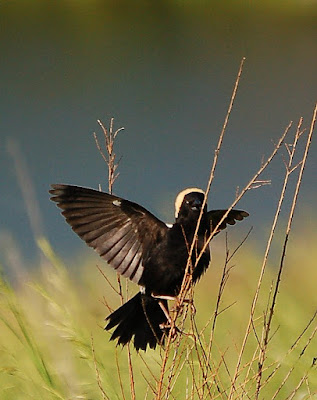
My best photos by far (with the exception of the sparrows in the hand) are those of the Eastern Bobolink. The field where we stopped to observe them was absolutely rife with them! The males were really pulling out all the stops to get the attention of the ladies. I was really excited to see and hear the Bobos, and to add this strange-looking bird to my life list.


A female Bobo, trying to decide on one suitor among many.


"Hey laaaaadies!" he's saying. Wow, for the longest time I've been trying to think of what famous person these birds remind me of with their clownish yellow cap, and it just came to me: Dennis Rodman.

Not exactly a compliment to the Bobo, but I see what I see...
And what is it with me and talking about the birds' "hair"?!


Check out those fantastic markings and colorings! If I was a girl Bobo, I think I might be impressed.


Either off to try his luck with a gal, or to go clobber on another male who's trying to take away his gal.


Here's a run-down of some other cool things we saw and heard:
  • Great look at an Eastern Kingbird flycatching.
  • Chimney Swift aerial mating display.
  • American Woodcock mating display flight heard (some of the participants witnessed on Saturday night, but I was in bed by then).
  • Awesome views of the Yellow-breasted Chat and Kentucky Warbler (usually very elusive).
  • Sighting of a wild Bobcat on the Wilds property (this is NOT a species they manage, it was a wild Bobcat).
  • Pair of Kestrels near a nest box, the female with a rodent in her talons to feed to the young.
  • Great views of Cerulean Warbler and Northern Parula Warbler.
  • Mama Wood Duck and 7 of her babies on one of the many lakes at the Wilds.
  • An insane replication of Barred Owl and Eastern Screech Owl songs by one of our trip leaders, Al Parker. The Screech Owl songs actually brought the real deal in right above our heads!

And here is a list of all the birds that I added to my life list over the weekend (for some reason I failed to do the Life Bird Boogie for any of them):
  1. Swamp Sparrow
  2. Warbling Vireo
  3. Acadian Flycatcher
  4. Eastern Bobolink
  5. Grasshopper Sparrow
  6. Henslow's Sparrow
  7. Savannah Sparrow
  8. Eastern Meadowlark
  9. Green Heron
  10. Orchard Oriole
  11. Rough-winged Swallow
  12. American Kestrel
  13. Horned Lark
  14. Kentucky Warbler
  15. Louisiana Waterthrush
  16. Yellow-throated Vireo
That's it for the birds, but I captured photos of some other things during the weekend. To be continued...

Monday, June 1, 2009

Sparrows in the hand

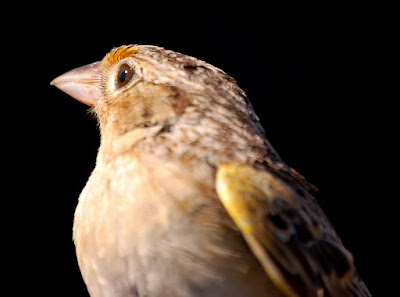
We birded in quite a few habitats during the Birding by Ear weekend at the Wilds, and one of those habitats was grassy fields, home to Bobolinks, Meadlowlarks, Horned Larks (all life birds for me!), and lots of sparrows. There was a gentleman by the name of Danny Ingold there on Saturday morning (Jim, can you help me with his name? I forgot to write it down in my notes!) who had some mist nets set up and he caught several sparrows that we got to examine (and photograph) up close. And - BONUS - I got to hold one of said birds! A life experience for sure! I don't have any photos of me holding my Grasshopper Sparrow (life experience + life bird!), but if I get some, I'll post them here. For now, here are some of the birds that other folks had in-hand:

Grasshopper Sparrow, the first of 2 that were caught (I held the 2nd one).


One of the distinguishing characteristics for ID-ing this bird by sight is its clear breast. The shape of the head is also a bit unique, as it's kind of flattened out on top (best seen in the top photo), like someone laid a big book on top of his head.


This is Jean, one of the camp participants, holding the Grasshopper Sparrow.


These birds surely had to put up with a lot of cameras. On the left is Jim McCormac, and on the right is Jean's husband. In the sunglasses is the gentleman who did all the bird catching.


The Field Sparrow was our next bird in the hand. We had several descriptions going around for his song: ball bearing, bouncing penny, bouncing ping-pong ball, and a fourth I can't remember.


Unfortunately I didn't get very many pictures of this little cutie (the only sparrow with an entirely pink bill).


Our final bird in the hand was the Savannah Sparrow (lifer).


Here you can see the streaking on the breast, as opposed to the clear breast of the Grasshopper Sparrow.


Like I said, lots of cameras on these little birds. They were amazingly calm given that we invaded their space so badly.


This Savannah Sparrow had been previously banded.


So very handsome.


I love this shot for the sharp focus on the face. That yellow eyebrow stripe is another good identifying field mark.

We got some great looks at a Henslow's Sparrow (lifer) on Sunday morning, but only by scope, so I wasn't able to get any photos of him. He was sitting on top of some Teasel, singing his little heart out. Watching him sing was something else, because the Henslow's really throws his head back to sing, but the song is really short, so he looks like he's sneezing or coughing. Since I was doing my fair share of sneezing and couging throughout the weekend, I felt he was a bird I could really identify with.

I'll have pictures of some more birds tomorrow!

Sunday, May 31, 2009

Birding by Ear "teaser"

Got back from my trip to the Wilds this afternoon. It was really amazing. Lots of life birds for me, one of which is pictured above. Do you know what it is?

I didn't get tons of great bird photos, but there are some. I will post more soon!
Posted by Picasa

Thursday, May 14, 2009

Plea to Ohio birders!

Hello! I'm using this post to make a very blatant plug for the Birding by Ear weekend coming up at the Wilds at the end of this month.

I received a phone message today from the reservations specialist at the Wilds stating that the camp may be canceled due to lack of interest. What a bummer! As of now the camp is still on, but if by next Friday, May 22nd, they have not received enough registrations, they will cancel the camp.

So, to all you Ohio birders out there: If you don't already have plans for May 29-31 and you'd like a chance to increase your birding by ear skills, this is the place for you to be! Our own Jim McCormac (of Ohio Birds and Biodiversity) will be one of the leaders at the camp. Here's a brief idea of what you can expect of the weekend:

"Come one, come all! Classes & activities are available for beginner, intermediate, and expert birders.

  • Learn from regional experts on birding research and sound ID
  • Find new list birds for the un-birded Wilds
  • Birding by canoe
  • Bird banding demo
  • Enjoy quiet nights around a campfire
  • Attract hawks with broadcasts
  • Search for owls and whippoorwills after dark
  • Explore the lands of the Wilds and AEP
  • Four catered meals provided by the Wilds' restaurant (Sat morning to Sun morning)
  • Bunk in Mongolian yurts for 2 nights (modern showerhouse is available)"
For more details and registration, click on the logo below. I hope to see you there!

Sunday, March 8, 2009

Birding by ear opportunity in Ohio


Attention all Ohio birders! (And any other birders who might want to travel to Ohio!) I want to tell you about a very special birding by ear workshop that's coming up at the end of May. It's the 5th annual Birding by Ear weekend workshop, being held at the Wilds from May 29-31. If you've been to the Wilds before, you know what an amazing place it is. If you have not been before, this would be a great "excuse" for you to go. Here's a brief synopsis of the weekend, as listed on their site:
  • Learn from regional experts on birding research and sound ID
  • Find new list birds for the un-birded Wilds
  • Birding by canoe
  • Bird banding demo
  • Enjoy quiet nights around a campfire
  • Attract hawks with broadcasts
  • Search for owls and whippoorwills after dark
  • Explore the lands of the Wilds and AEP
  • Four catered meals provided by the Wilds' restaurant (Sat morning to Sun morning)
  • Bunk in Mongolian yurts for 2 nights (modern showerhouse is available)
I got my first taste of the Wilds last September when I attended a very cool weekend photography camp (which will be back by popular demand this year, this time on 2 separate weekends). It was someplace I had been wanting to go for years, and what better excuse to go than to get my photography learnin' on? Well, now I'm gonna get my bird learnin' on! I am so psyched!

To help me get prepared for both this trip and spring migration in general, I have two books that I'm using:


The Backyard Birdsong Guide (available for both eastern and western North America) is written by Donald Kroodsma, a "recognized expert on bird songs," according to the Cornell Lab. The book was written in conjunction with the lab, and all of the recordings are from the lab's own Macaulay Library. I haven't compared them, but I bet many of the recordings are the same as the ones on the lab's All About Birds pages. This book is unique in that it has an audio player built right into the book. The book also features range maps for each bird featured, as well as multiple recordings for most of the birds.

The Songs of Wild Birds by Lang Elliott comes with a CD that showcases the songs and sounds of 50 different birds, along with some commentary by the author. The book contains beautiful color photos of each featured bird, many of them actually caught in the act of singing.

A third tool in my birding by ear toolbox is a CD put out by the Ohio Division of Wildlife, and it features the songs of the 99 most common birds of Ohio. (Ever notice that Cardinal wildlife icon over in my sidebar? The purchase of these special Cardinal license plates helps to support the Division of Wildlife, and to make projects like this CD possible.)

So, my fellow Ohio birders, are you up for some good birding fun at the end of May? If so, I'll see you at the Wilds!


By the way, I have a funny little "you know you're a bird geek when..." story to share. The other night Dave and I were watching an episode of Star Trek: Voyager, and there were some birds on the planet they were exploring. Funnily enough, the song of the Eastern Wood Pewee (one of my favorites!) was used a couple of times. The first time we heard it, we were like, "Wait, was that a Pewee?" The second time we heard it, we knew it without a doubt. Yes friends, they have Pewees in the Delta quadrant - who knew?!