Saturday, March 3, 2012

Today I saw: American Kestrel

For a while I've been kicking around in my mind the idea of doing some serial-style posts that detail bird sightings and observations that I think you, my dear readers, might find interesting. Think of it as a "birders notebook" type of entry. I have shied away from the idea partly because there will invariably be birds that I do not have photos of from my own personal collection, meaning I will have to rely on online sources where I can get free images that are allowed to be used for public/educational distribution. Why? Because no one wants to read a post where there are NO pictures, but I will not just "lift" photos willy-nilly from web pages just to get images for a blog post. So we'll see how this goes. This will be my first installment of "Today I saw..."

Kestrel image provided by Clipart ETC, originally published in 1869 in Louis Figuier's Reptiles and Birds.

Today I saw an American Kestrel. It was perched on a phone wire along a mildly traveled county road, looking out into a corn field, prime habitat for this falcon. At first glance I wasn't sure that it was a kestrel because it was not doing its characteristic tail bobbing, a behavior that is a "gimme" for quick field identification. Luckily, there was a spot just up the road where I could safely pull off, and I was able to hop out with my binoculars and work my way toward the bird. Not having had a ton of experience with kestrels, I wanted to get a better look at it, just to be sure about the ID. My curiosity was well-rewarded.

As I approached I noticed another bird on the wire, which was a Rock Pigeon, and the still-in-question kestrel was quite a bit smaller than the pigeon. American Kestrels (also known as "Sparrow Hawks") are the smallest falcon in North America, so it was good to see this size comparison in person. For reference, Rock Pigeons are about 12"-14" long, whereas American Kestrels are about 9"-12" long. As far as field marks go, the lighting was not great, so it was a bit difficult to see any field marks well, but I was able to pick up barring in the wings and some vertical striping on the head, so I was pretty confident by this time that I was looking at a kestrel, even though it never bobbed its tail once while I saw it on that wire.

A cold, biting breeze was blowing, so it was time to head back to the car. Just a few feet from my car I took another look out into the field, and saw a dove-like figure flying over the field, except it wasn't behaving in a dove-like fashion. This bird was obviously hunting, so I knew I was seeing the kestrel. I quickly forgot about the chilly breeze and enjoyed the show this small raptor was putting on. It was hovering with shallow but fluid wing beats, and at times it was able to catch the breeze just right and simply hang in the air for 5 seconds at a time. When not hovering, it would fly in a roughly circular pattern over the area it was hunting, and I was finally able to pick up the rusty coloring of its back and tail. Such a slim, graceful bird it was. It dove to the ground twice, but both times it come up empty-taloned. Here's an interesting factoid that I gleaned from the Cornell Lab of Ornithology's All About Birds site:
Unlike humans, birds can see ultraviolet light. This enables kestrels to make out the trails of urine that voles, a common prey mammal, leave as they run along the ground. Like neon diner signs, these bright paths may highlight the way to a meal—as has been observed in the Eurasian Kestrel, a close relative.
It then took off to another portion of the field, and maybe eventually made its way back to the perch on the phone wire where I had originally spotted it. I was glad I took the time to stop and watch this bird. The observations gave me a good field experience that adds to my growing mental library of bird behavior, and gave me a good opportunity to share this bird with you.

Sunday, February 26, 2012

A certain stillness

Last weekend was the Great Backyard Bird Count, which normally has me planning to go to different locations to count birds. That was indeed my original plan, but life had other ideas. Last Saturday morning I awoke to a sick dog, and unfortunately he did not get better as the day progressed. A time that we had been anticipating and dreading had finally come. It's hard to believe that it's been a week since we had our poor, sweet Emmett put to sleep.

Our house is now feeling a bit empty. Emmett was the last of a host of pets that Dave and I have had the pleasure of knowing over the last 11 years. At 15-1/2, he was the oldest of them all. His sister, Jupiter, passed away a little over 2 years ago, just shy of her 13th birthday.

Amid all the bird songs that I hear daily now that are a sure promise of spring, a certain stillness hangs in the air. It's hard to adjust to not having a wagging tail and happy puppy to greet us when we get home from work. But instead of focusing on the things that are difficult, let me share some happier memories with you, memories of both Emmett and Jupiter.

I didn't know them as puppies, unfortunately - they were already full-grown by the time Dave and I started dating. I met them both the first time I came to Dave's place, and they were both very accepting of me, which was something that I felt was important if Dave and I were going to be a couple. I was especially grateful that Jupiter, the "other" girl in his life, took a liking to me.

They were both very cute adults, but as puppies... well, it was just ridiculous.

Emmett was quite a little ball of fluff. It took him a little while to grow into his face and his ears, though.


Emmett in his "adolescence."


And Jupiter in hers.


They loved to chase each other and play. I can't tell who's chasing who here, but I can hear them going "nyyeeeaaawwwwwrrr," round and round in circles!


They also liked to bite on each other, especially Jupiter on Emmett. This is when they were wee pups...


... and as adults. It's a move Jupiter would repeat over...


... and over. Eventually, many years into adulthood, Emmett finally developed a strategy to shake her off when she chomped on him like this, and it was a move that I called the "butt block." Actually, it was more of a hip block, where he'd ram his hip into her to get her off of him, but "butt block" sounds way more fun.


This isn't to say that he didn't get his own chomps in on her, though!

Their exact lineage is unknown, but "husky mix" was the breed reference we always gave. Having husky blood meant they liked to roam, often quite far from home. They always came back, but Dave and Jupiter one day learned the hard way that some folks don't take kindly to having strange dogs on their property. Jupiter got shot in her rear left leg, and fragments of the bullet stayed with her until the end. Living on 8 acres in the country made containing the dogs a challenge, to say the least. A radio fence was employed after the shooting incident, but both Emmett and Jupiter were masters at finding ways to get through the field of the fence, and they were always testing it, waiting for those times when a rodent chew or a deer run-through caused a break in the line, leaving the whole system down.

The day Dave asked me to marry him, the dogs "broke out" and came over into the field where we were (across the road from the house) to congratulate us. They didn't want to be left out! This was one time that we didn't mind that they were naughty dogs who disobeyed the rules.

Overall, they were good dogs. For as long as I knew them, they were outside dogs 90% of the time (with plenty of shelter available when they needed it, of course), and they seemed very content being that way.
They both loved the snow...

... and they both loved a good leaf pile.


And we loved them both very, very much. Two weeks before Emmett reached his end, I was able to get some nice photos of him. When I look at this photo now, it still tugs at my heart strings, but it also makes me smile. It captures his essence very well.

We miss you, dear friend. Rest in peace.

Sunday, February 12, 2012

Oh, how I love my birds

In my last post, I mentioned how Carolina Wrens are the apple of my eye as far as species that dine at my feeders in winter go(or any time of year, really). If a weekend of counting for Project FeederWatch goes by with a goose egg on my list next to "CAWR"* (the 4-letter shorthand, known as bander's code or alpha code, for CArolina WRen), it makes me sad. I worry.

This weekend I was sitting at the dining room table having a late breakfast, and I wondered out loud if "my" wrens were okay, because I had not yet heard a peep from them or seen them. Oftentimes they are one of the first birds I hear in the morning, so that was why I was a little concerned. Not to worry, though. As soon I finished posing the question to my bowl of cereal, up popped a wren onto the railing and right into the bowl that holds the bird dough.

It's when things like this happen that I can't help but wonder if there is some kind of connection between myself and the birds. I mean, come on! Wonder about the bird and then it shows up immediately thereafter, as if conjured?!

Don't worry, Heather - we are here and we are fine. Now, if you don't mind, I'm just going to sit in the food.

There were actually 2 of them sitting in here at one point, but I wasn't fast enough with the camera to get a shot of that. In total, there were 3 Carolina Wrens at my feeders at one time this weekend, as was the case last weekend. I had 3 of them at one time in early December, too. This is remarkable because this is the first year in 7 years of counting for FeederWatch that I've ever seen 3 Carolina Wrens at once at my feeders.

Contemplating his/her next bite?

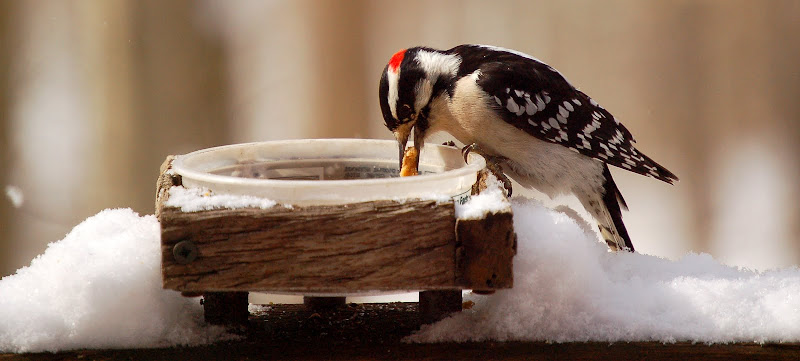
I also enjoy the woodpeckers, and we get three species of them reliably: Downy, Hairy, and Red-bellied. The Downies seem to be the most tame of the three, readily coming in to the suet feeders even if I'm standing right next to them. This sweet little female Downy Woodpecker looks like she just landed, what with the little spray of snow under her tail.

Tra-la-la, minding her own business, making sure I'm getting her good side...

... then this feisty fella shows up. Doesn't he look MAD?! His little head feathers are all puffed up, full of 'tude.

Here's a look at his puffed up mane from the back:

And even though he's chased the female away by now, his bravado continues:

Oh wait, never mind. It's all cool. No problems here, lady.

Lemme jus' grab a big ol' hunk o' dough...

And get on outta here!

I soooo love this shot, caught serendipitously by depressing the shutter at just the right time, of course. It almost has the feel of a raptor caught in flight rather than a woodpecker.

Yes, friends, these are just a few examples of why I love my birds. They are wonderful in every way.

*Okay, regarding the alpha code for Carolina Wren... CAWR isn't technically correct, because that abbreviation could also refer to 2 other wren species in the United States: CActus WRen and CAnyon WRen. The correct bander's code for each of these species is as follows: CACW (Cactus Wren), CARW (Carolina), and CANW (Canyon). I use CAWR for my wren, though, because the chances of me encountering either of the other 2 species, which live out west, is pretty remote at my feeders. Besides, it's shorthand that's supposed to be easy for ME to read. But I digress.

Tuesday, February 7, 2012

Vultures, creepers and wrens - oh my!

So what was I talking about when last I blogged... Birds, you say? Well, here's some more bird stuff.

Vultures are common where I live in southeast Ohio, and they are here year-round. This has not always been the case, but it's all I've ever known since I started birding and paying attention to such things. Folks up in northern portions of the state are starting to see their first Turkey Vultures of the year, but Turkey Vultures, as well as Black Vultures, abound in Athens and Hocking Counties (and probably many other southeast Ohio counties). My interest in Black Vultures in Athens County began around this same time last year when a large group set up camp on and around an empty house along my route to work (click HERE to read that post). This year they continue to fascinate me as I try to figure out where they are roosting around town.

One reliable spot, I have found, is The Ridges on the Ohio University Campus. This area used to be known as the Athens Lunatic Asylum, but now it houses university offices, the campus recycling center, and an art museum, among other things.


One Black Vulture among many, coming in for a landing. Notice the bits of whitewash along the brick wall. Yeah, that's vulture poo.

The Black Vultures that I've been seeing during the past few months have been flying rather close to downtown Athens, and I see them often on the days that I choose to walk Uptown (that's what we call downtown in Athens) for lunch. They swirl around down low, and they are sometimes found flying close to the local middle school, which is a little creepy (don't fly off with one of the kids!)
As I've been studying the vultures these past months, I've been tricked by several different shapes they can take in flight. We mostly think of them soaring, which they certainly do, but I've learned that they look very different when they are actively flying and really trying to cover some ground to get from point A to point B. So just because its wings aren't outstretched doesn't mean it's not a vulture.


Turkey Vulture in a hurry

I've also had to really concentrate on field marks to separate the Black Vulture from the Turkey Vultures in flight. The tail should be a reliable clue (short and stubby on Black Vultures, longer and more round on Turkey Vultures), but sometimes it's not the best indicator for me. The white "finger tips" are probably the best marking to look for, but the light has to hit at just the right angle for that to really show. I'm also getting a better feel for the relative sizes (Black Vultures are smaller then Turkey Vultures.)

One of each. Can you tell which is which?

In case you thought I only cared about the Black Vultures, here's a small roost of Turkey Vultures, also found at The Ridges, but quite removed from the spot where I photographed the Black Vultures. Normally they don't make any noise, but sometimes they do hiss, as the top-most Turkey Vulture in this photo is doing.

Another bird that's been high on my fascination-meter this winter is the Brown Creeper. I've seen more Brown Creepers this winter than I ever have, and have spotted them on at least 15 different occasions. While I don't get the impression that they are terribly uncommon, they certainly aren't as abundant as, say, woodpeckers or chickadees. They put me more in the mind of Carolina Wrens, who seem to have a fairly high territory:bird ratio (meaning few birds to a large-ish territory). One thing is for sure: a Brown Creeper is not a bird that you're going to just stumble upon. You've got to know what to look for, and more times than not it will be their sibilant call note that will alert you to their presence.

For example, there are 2 birds on this tree, a creeper and a woodpecker. The woodpecker is peeking, and I'm positive you can pick it out, but I bet you're in a pickle to point out the presence of the creeper.


Here we are, zoomed in. The cute little creeper is just below dead-center. See why they're so hard to spot? Blend right in with the bark. That's some camouflage, eh?


Please pardon the quality of this photo, but it is severely cropped. This was one of the few times when the creeper was at the base of the tree, and there's at least a little contrast with the moss that's around it. It's hard to see, but there's a band on this bird's leg. I photographed this Brown Creeper at the house of my friend Bob Scott Placier, who is a licensed bird bander. He has banded at least 4 of these little gems in recent months, and they have a steady supply of food at Bob's, so they'll probably stick around until it's time for them to migrate north for breeding season.

On the home front, the birding has been pretty steady this winter, with the same 14 species (give or take 1 or 2) showing up reliably each weekend that I count birds for Project FeederWatch. We had an ice storm a few weeks back, which finally brought a pair of Eastern Towhees and an American Tree Sparrow to my feeders, but otherwise it's been a predictable cast of characters.


Singing male Carolina Wren, the apple of my eye at the feeders. Any time I put something special out, like mealworms or homemade bird dough, I tell them out loud that I've put out something just for them. It's for all of the birds to enjoy, of course, but a special kind of joy comes over me when the wrens show up.


I love watching the woodpeckers at this little feeding station - the distance from the railing is perfect for tail-propping.


And no feeder watching session would be complete without a visit from at least one Sciurus carolinensis, or eastern grey squirrel.

Good birding!

Sunday, January 8, 2012

Putting birding skills to use

One of the most rewarding aspects of birding for me is being able to put something that I recently learned to use by making new discoveries of my own based on that learning.  I had one such experience today.

I was walking along our rural road, enjoying the sunshine and abnormally warm temperatures for January.  I stopped often to look and listen for birds.  One particular area caught my interest for some reason, maybe because I don't normally pay much attention to this particular spot, or maybe I caught some special birdie vibes.  I saw movement in the grass, heard some Song Sparrows and saw some other sparrows that I couldn't make out well enough to positively identify.  Then I heard a chip note that caught my ear.  At first I thought it was an Eastern Phoebe, which would have been a really cool find for this time of year.  Once I got my binoculars on the culprit, though, I realized it was a Swamp Sparrow.  I was especially excited about this because this was a new find for me along our road.

What was more intriguing to me, though, was the fact that I had been tricked by this Phoebe-sounding chip note just about a week ago while doing the Hocking Hills Christmas Bird Count (CBC).  My neighborhood habitat is very similar to that of our CBC Swamp Sparrow habitat: close to a creek, with lots of overgrown grasses in a low-lying area that's known to get wet (and stay wet) after too much rain, and with moderate but spotty tree density.  When we first heard the "chip!" during the count, our group leader, Jim McCormac, thought it was a Phoebe.  The closer we got to the source, though, the less convinced we were that it was actually a Phoebe.  It eventually dawned on Jim that it was more likely to be a Swamp Sparrow.  While we never actually saw the bird in question that day, after comparing recordings of a Phoebe "chip" to that of a Swamp Sparrow "chip," all 3 of us agreed that what we were hearing was a Swamp Sparrow.


Swamp Sparrow in winter plumage. Photo by Kevin Bearcaw, via Wikipedia

Sure enough, I was being confronted with the same situation on my home turf.  Only this time I got to see the bird.  I even went so far as to walk back home and get my spotting scope so that I could get a really good grasp of what this bird looked like.  To look at it, it seems like not a very exciting bird, unless you like trying to categorize different hues of brown, rust and grey.  I have to admit that I would be hard pressed to identify this bird by looks alone simply because I haven't seen very many of them.  (I can tell you a Song Sparrow from a White-throated from a White-crowned from a House, but that's about the extent of my ability to ID sparrows on sight.  They don't get the nickname "Little Brown Jobs" (or LBJs) for nothing!)

Swamp Sparrows winter in southern Ohio, but it seems few stick around these parts for breeding season.  Preliminary data from the recently completed 2nd Ohio Breeding Bird Atlas (2006-2011) show, however, a handful of confirmed breeding locations in the southern 3rd of the state.  This is in stark contrast to the last Ohio Breeding Bird Atlas (1982-1987), which shows possible and confirmed nesting only in the northern 2/3's of the state.  Having now seen (and heard) this bird in my own neighborhood during winter, I will now be keeping a watchful eye out for a possible breeding record this coming summer.  Now THAT would be exciting!

Thursday, January 5, 2012

Hocking Hills Christmas Bird Count

Snow-flocked Hemlocks in the Hocking Hills
January 2nd turned out to be a cold, brisk, wintry day, perhaps not the best of days to be out birding.  The roads went from dry to snow-covered in a matter of hours, and we found ourselves in near white-out conditions at a few points in the day.  As a result, the birds stayed hunkered down for the most part, except for a few pockets of activity here and there.  I had hoped for at least 40 species for the day, and we ended the day with 44 species; however, only 35 of those were in our count territory - the other 9 were "borrowed" from Lake Logan, which was the territory of another count group.
I'm glad we stopped at the lake first thing, though, because there was much waterfowl to be seen.  Due to the mild weather that we've had thus far, the water was completely open (i.e. not frozen), so there were many more waterbirds than one would find if the lake had been even partially frozen.  We saw several good-sized rafts of American Coots and Hooded Mergansers (with females greatly outnumbering males), a couple of Pied-billed Grebes, a Double-crested Cormorant, and a Horned Grebe.  Please let it be noted that, with the exception of the Coots (and maybe the Mergs), I probably wouldn't have been able to ID the other waterfowl due to utter lack of experience (especially since they're all in basic, or non-breeding, plumage right now!).  Thanks to our fearless leader, Jim McCormac, for pointing out all these great birds!

As strange as it may sound to some, I find an odd type of enjoyment in driving around and stopping and looking and listening for birds.  Of course, this is all done on rural roads, so traffic is not too much of an issue, but you do have to be mindful of private property.  We stopped and "staked out" a couple of yards with feeders, and if the homeowners would have happened to look out while this car full of people with binoculars was checking out their house, they might have been a little alarmed!  One of these feeders got us our only House Finch of the day, though.

My bird count partners, Olivia and Jim.
Some species came easily, and were spotted or heard at almost every stop, with the American Crow probably taking the prize there.  Dark-eyed Juncos were also observed in great numbers (101 for the day for our group, I believe).  Other species like Carolina Chickadee and Tufted Titmouse were observed in surprisingly low numbers, especially given the number of forested habitats we encountered.  We got all 5 woodpecker species that we expected (Downy, Hairy, Red-belied, Northern Flicker, and Pileated), but we had to work really hard for the Hairy, and all the Pileateds were silent fly-bys.  That's one woodpecker you tend to hear more than you see it, but not on this day.  We had 4 Belted Kingfishers for the day, which I thought was a high number, but very few Starlings or House Sparrows, both of which I would have expected to see in decent numbers simply due to their commonness.

Surprises for the day came both in the form of what we saw and didn't see.  The aforementioned Horned Grebe was a nice find, as were several hearty-souled Savannah Sparrows cavorting with a large flock of Juncos, a Bald Eagle soaring over Lake Logan, and a few Killdeer holding out on the mudflats at the lake.  We had several misses, too, that were disappointing: no Turkey Vultures (did see a number of Black Vultures, though), no Red-tailed Hawk, and no American Kestrel.  Regarding the latter two, I suspect our chances would have been better if the weather weren't so dreadful.  Who wants to be teed up in a tree or perched on autility line when the wind is blowing the snow sideways?  We had also hoped and tried for Red-breasted Nuthatch, Winter Wren and maybe an overwintering Eastern Phoebe, but no luck.  And so it goes.

The day wrapped up at Crane Hollow Nature Preserve, where we had a group gathering and pot luck.  It was nice to sit in this warm, cozy house with some yummy snacks and in the company of friends, new and old, while we compiled the day's findings.  It was a wonderful way to start the new year!

Here's the full list of species that our group saw and/or heard, if anyone cares to know:
  • Hooded Merganser
  • Double-crested Cormorant (new for the Hocking Hills count!)
  • American Coot
  • Canada Goose
  • Pied-billed Grebe
  • Horned Grebe
  • Mute Swan
  • Mallard
  • Killdeer
  • Belted Kingfisher
  • Bald Eagle
  • Red-shouldered Hawk
  • Northern Harrier
  • American Crow
  • Norther Cardinal
  • Blue Jay
  • Carolina Chickadee
  • Tufted Titmouse
  • White-breasted Nuthatch
  • Brown Creeper
  • Song Sparrow
  • White-throated Sparrow
  • Dark-eyed Junco
  • Savannah Sparrow
  • Swamp Sparrow
  • American Tree Sparrow
  • Eastern Towhee
  • Hermit Thrush
  • Eastern Bluebird
  • American Robin
  • Pileated Woodpecker
  • Downy Woodpecker
  • Hairy Woodpecker
  • Red-breasted Woodpecker
  • Northern Flicker
  • Mourning Dove
  • American Goldfinch
  • House Finch
  • Carolina Wren
  • Golden-crowned Kinglet
  • Black Vulture
  • Northern Mockingbird
  • House Sparrow
  • European Starling