Saturday, May 14, 2011

Moths on our cabin

In addition to the plethora of birds that I was bound to see and hear at the New River Birding and Nature Festival, I eagerly anticipated encounters with other fauna that I knew would be abundant in this richly forested area of West Virginia. I had heard good things about moth encounters at the restroom at the Burnwood day-use area (directly across SR 19 from the New River Gorge Canyon Rim Visitor's Center). I've never looked forward to seeing a bathroom so much in my life! Unfortunately, many of the evenings during our week-long stay were quite cold (some nights dipping down into the 30's), and cold nights are not conducive to moth activity, no matter how attractive the lights.

As luck would have it, though, we kept the back porch light on at our cabin every night, and we were treated to some very nice moths right outside our back door on the warmer evenings. These were actually all photographed during daylight hours, and I suspect that the afternoon sun that beamed onto the wood siding on the back of the cabin was inviting to them as they warmed up in preparation for evening flight.

Here's a Rosy maple moth, Dryocampa rubicunda. This little show stopper greeted us the day we arrived at the cabin, staying tucked up against the door frame. This was my first encounter with the moth, but Nina had seen this on previous treks to New River and was able to identify it right away. As its common name implies, the host plant for Rosy maple moth caterpillars are maples, such as red maple, sugar maple and silver maple.

My moth ID skills are horrible, so I can't tell you who some of these beauties are (I can't wait until Seabrooke Leckie's new moth guide comes out in 2012!). To anyone out there who is more knowledgeable, I would love to be informed of their identities.

This moth seems like some kind of leaf mimic to me. Wonder what it would have looked like with wings spread out?


This unknown moth looks like it escaped an encounter with a predator based on the chunk missing from its wing.


Here's another one that's looking a little on the tattered side. I saw a number of these on our cabin, and they all liked tucking themselves up under the wood siding.


I really love this one for its coloring. It puts me in the mind of lichen.


This view is even better. The markings on the upper "back" look to me like closed eyes with big false eyelashes on them.

All of these moths so far are on the relatively small side (bodies a couple of inches in length, and most could probably fit on a half dollar piece with wings closed). We were very lucky, however, to see the largest moth of the trip one afternoon later in the week.

This is a member of the silkmoth family, Saturniidae, and some internet searching the day that we encountered this moth turned up the name Promethea moth, Callosamia promethea. Pretty stunning, right? Well, wait till he opens his wings - the difference is like day, and... night:

Yes, this really is two pictures of the same moth. The males can be told apart from the females by the black coloring of their open wings. The photo is blurry because this guy didn't hold his wings still once he had opened them.
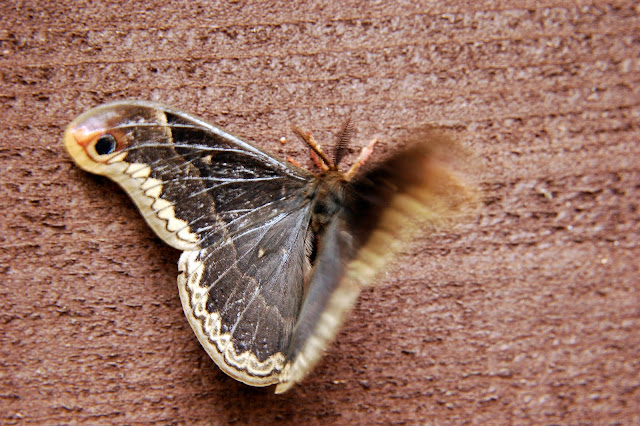

Nina and I were able to snap a few photos of him with open wings before he took off, never to be seen by us again. Interestingly, Jim McCormac found a female Promethea moth hanging out on his cabin, which was maybe 200 yards away from ours. I wouldn't be at all surprised if our male moth paid his female moth a little visit, if you know what I mean. Read more about Jim's encounter with the Promethea HERE.

Having said that my moth ID skills are not very good, I came across something confusing on the Butterflies and Moths of North America website when I was trying to learn more about the Promethea moth: there is a VERY similar-looking moth called the Tuliptree silkmoth, Callosamia angulifera. Being not well-acquainted with these creatures, I never would have been able to call the ID on my own. It seems similar to the novice birder's attempt to distinguish a Downy Woodpecker from a Hairy Woodpecker, or a Cooper's Hawk from a Sharp-shinned Hawk, if you've only seen one and not the other and have no reference on size or habits. To make matters more confusing, both will use Tulip tree (Liriodendron tulipifera) as a host plant for their caterpillars, and there was an abundance of Tulip trees around our cabin.

A tidbit about the silkmoths is that the adults do not feed. They emerge from their cocoon, mate, lay eggs and die, often in a matter of days. When I learned about this a few years ago, it boggled my mind, and it still does. I imagine there has to be a name for this type of life cycle, and I've been scouring the internet for such information, but so far I have come up empty-handed. It's information and questions like these that keep me ever-interested in the complexity of nature.

Wednesday, May 11, 2011

Intense birding in West Virginia

I returned home from the New River Birding and Nature Festival 3 days ago, but I'm still adjusting my brain and my internal clock to "the real world." Over the next week or so I'll roll out posts that detail what kinds of things I saw and heard there, but right now I have to try to put into words the essence of the festival before it all slips away and seems like a dream.

At the encouragement of my friend Nina, I signed up for the full week-long deluxe package, which included lodging in a wonderful little cabin in the woods at Opossum Creak Retreat, 3 meals a day, birding by day and presentations each evening after dinner. That week was total immersion in birds, botany and natural history. Put another way, as quoted on the New River Festival website, it's a week of "birding, ecology, friendship and fun."

I've never been to a birding festival before, but I think the bar has now been set pretty high for any future bird outings that I might go to. They really take care of you at the New River Festival. For one thing, having your meals provided for you is a huge convenience that I didn't appreciate until I came home and realized that I had to go back to fixing my own meals. This may sound silly, but it's just part of what lets you devote ALL of your attention to birding - someone else worries about all of the logistics for you (a HUGE thanks goes out to Dave Pollard for that - thanks, Dave!), while you just sit back and enjoy the birds. A bus drives you to the designated trip locations, lunch comes with you, and you have access to the guides basically from dawn till dusk. Groups are kept small, with a ratio of approximately 10 guests per guide, for maximum learning potential. Have a target bird in mind? Let the guides know, and they will do their best to get it for you.

Morning comes early, with communal breakfast at 6:00, and then you're on the road by 6:45. I had to laugh some mornings when I would look at my watch to see it was only 10:00 or so, thinking to myself, "Wow, I've been birding for 3 hours already!" Most trips would return by 2:00, giving you a few hours of down time in the afternoon, but there were a few day-long trips available that kept participants out until 8:00 or 9:00 at night (including dinner, of course). It was intense, to say the least. We were all a little loopy by the end of the week, I think, due to lack of sleep, but the intensity was worth it. I was speaking to someone on one of the trips about time I spent in France as a college student, where I was immersed in the language and the culture for a handful of months. This birding trip was not terribly unlike my time in Paris. It was full-on immersion into the world of bird behavior and bird song, and it give me such a better understanding of the habitat requirements of all the birds I saw (a diverse mix of habitats are covered over the course of the week if you pick the right trips). I left for this festival with a desire to get to know my warblers better, and I feel like that goal was reached. I knew that all the learning had paid off when, during the return trip home, I was able to easily recognize some birds that were still relatively new to me during a quick stop to do some road-side birding 30 minutes away from my house.

In addition to the immersive nature of the festival, there was also an insular feel to the event, which was not something that I expected going into it. It was as if we were in our own little birding heaven, giving thought to little else. Not much news from the outside world reached me during the week. I heard about the killing of bin Laden on Monday morning, but other than that, I was removed from news. Nothing about the royal couple, nothing about this reality personality or that movie star or this million-dollar company buying out some other company. I chose not to watch television or listen to the radio. This was my first true vacation from news media in quite some time, and it was refreshing! Even my social media contacts were limited mostly to other folks who were making Facebook posts about the festival. Yes, we were all right there together, talking face to face, but also communicating via Facebook. While social media (including the good ol' telephone!) kept me somewhat tethered to the outside world, mostly I felt like I was on a very special little birding island, where all I wanted to do was learn about and observe birds as much as possible, and that was okay with everyone around me.

As much as I birded, I didn't get many bird photos due to the constraints of my equipment. And while I birded hard, I also took time to appreciate some other aspects of my surroundings. I'll tell you more about that in upcoming posts.

Saturday, May 7, 2011

Sit with me

Another springtime entry from the archives...


Ground Ivy

Cool breezes and lazy clouds. Sitting on a wooded hill, dog at my side, surrounded by Spring Beautys, listening to the first calls of the Brown Thrasher. Waiting... watching... found him! Soaking in the sun and the sounds - and the silence. Taking pictures of wildflowers, watching the Bluebirds visit a nest box, crossing the creek. Paddling in kayaks with my beloved, floating the lake. Watching a Kingfisher, then a Great Blue Heron. Spotting from afar Trillium blooming near the bank, coming closer to also discover Toad Lily mixed in. Beauty abounds all around. If only all days could be this perfect.

Thursday, May 5, 2011

Curious people are my favorite

For those of you who haven't been paying attention, I'm currently in West Virginia at the New River Birding and Nature Festival, a week long festival of blissful birding, botanizing and other enjoyments of nature, ecology and natural history.

There are many, many great aspects to this festival, one of which is that we all have one thing in common: a curiosity for the natural world. It might be just birds, or birds and plants, or birds and plant and moths... no matter what the subject matter is, everyone is here to learn something and see something new, and to experience nature in all her glory.

Since I am naturally very curious myself, it makes sense that I like to hang out with other folks who are curious, too. When the curiosity is over a shared interest, then we understand perfectly why a group of people would choose to stand around and look up in the trees for a long, long time in search of a bird.

But for all the time we spend looking up in the trees for birds, we spend almost an equal amount of time looking at the ground for any number of things. Insects. Plants.

Nina photographing cinnamon fern fiddleheads.

Poop Scat.

Geoff Heeter photographs Jim McCormac photographing bear scat.

Not only do we look at poop scat (we need to be adult and professional about this, right?), we get EXCITED about it. This was a big fresh black bear pie. Our field experts estimated it was a few days old, and it was mostly comprised of leafy green vegetation. It didn't take long for the serious investigation to begin. You will notice in the photo above that the fellow in the top left corner is coming at the pile with a stick. It was by prodding into the pile that we could get an idea of what the bear had been eating.

Of course, when you have a find this good, you have to share it with everyone!


Our intrepid scat sniffer and co-trip leader for the day, Rudy Gelis. If you ever want to go birding in Ecuador, Rudy's your man.


So, yeah... curious folk are cool. So is this festival. I'll tell you all the other reasons why in the coming week.

Wednesday, May 4, 2011

Thinking spring: reprise

Another post from the archives...

Spring is settling in here quite nicely as we march on toward May. Perhaps a little too nicely, I had feared. The numbers registering on the thermometer have risen to summer-like levels on more than one occasion, making me wonder if we're just going to skip over spring entirely. That happened a few years back. This past weekend came to us with highs in the upper 50's, though, so I guess spring still has a bit of a hold on us, and we surely haven't said good-bye to nighttime frost yet.  That just wouldn't be right.


Right now we are in "The Season of Explosion." One day you go out and don't see much. The next day you go out and -POOF-! There's suddenly so much color. And the next day -POOF!- again, more color. It just keeps going and going. We'll reach a saturation point eventually, but for now, I'm enjoying the explosions and the prospect of new beauty every day.

While beauty abounds, this time of year does have its challenges.  Even  the process of planting flowers can take on a life all its own.  All it takes is one new or unfamiliar bird sound to make me drop my spade and forget all about the planting.  My attention shifts entirely to craning my neck and locating the bird in question.  Even though the trees are only just barely leafed out, birds that like to flit about high in the tippy-tops of the trees are still a challenge to find.  At least I'm finally learning to bring my binoculars out with me when I step outside, because I know I will need them.

The Buckeye trees, of which we have many on our property, have already put out their five-fingered leaves and are giving us a nice taste of the dappled sunlight that will reach us once all the leaves are out.  It's a slow encroachment, but day by day, tree by tree, our house will become enrobed by an array of green finery.

I'm already looking forward to all the baby birds that will be fledging over the next few months.  The Phoebe nest on the side of our house has been attended by a very devoted mother for the last few weeks.  Any day now I expect to start hearing some peeps from that nest.  A pair of Starlings have built themselves a nest in a roost box we put up years ago, an avian dwelling that so far as we can tell no one has ever used since we installed it.  A pair of Bluebirds has occupied one of the 3 nest boxes across the road, and there were 4 eggs in it at last count. 


Male Bluebird with a fresh lunchtime delivery for babies, May 7, 2006

 And I finally caught sight of a pair of Mourning Doves getting a quickie in Sunday afternoon.  They've been flying about and sitting on branches as pairs for weeks, so I imagined I would catch them in the act at some point.  Blue-gray Gnatcatchers are buzzing about (and quite loudly at that) every day in the woods - I can only hope for a glimpse at one of their nests.  And the Brown Thrasher sings boldly every morning and evening from the edge of the woods across the road; his ever-changing pattern of double calls is so intriguing to me.  If I'm lucky, I'll spy one of their nests just at the edge of the shrub line like I did several years ago. 


Brown Thrasher on the nest, April 26, 2007

Oh, and the woodpeckers - mostly Downys, but also Hairys and Red-bellieds - I can't wait to see their little ones come to the suet feeders, just like they do every summer.


Male Downy Woodpecker feeding one fledgling while another waits in the wings, June 11, 2006. The fledglings crack me up when they perch right on the suet feeder and beg and beg, refusing to feed themselves, which is what's happening here.

Of course, in addition to hoping to catch a glimpse of some nests or young birds, I'm just enjoying the sound of migrants and summer residents as they make their way north for the warm months. A Hermit Thrush stopped me in my tracks one morning as I was getting ready for work. I've never heard one of them on our property before, and, sadly, I haven't heard it since that morning. I anxiously await the return of its cousin, the Wood Thrush. Over the weekend I heard the White-eyed Vireo talking about pick up the beer tab, chick, and a Blue-winged Warbler put its fingers up to its ears, waggled them around, inhaled loudly, and made a big raspberry noise (that's just what their beee-buzzz voicing sounds like to me).

Once the birds start to migrate in and the woods start to explode, the phrase "I'm going for a walk in the woods," has to be taken rather loosely. It's not so much a walk as a dawdle, but the dawdle has a purpose. For example, I may end up backtracking 50 feet because I'm trying to find a bird that keeps flying away. Or I MUST stop to look at every different wildflower, checking it against the catalog in my brain - "Ooh, I don't know this one. I'll have to look it up when I get back to the house." But who knows how long it will be before I get back to the house. When the weather is good, everything about the outdoors begs to be soaked in through every available sense.  Oh how I wish I could spend all day, every day, out and about, observing and noticing. Sigh.

Monday, May 2, 2011

Nestboxes for rent

While I'm away birding in West Virginia, I'm re-running some of my favorite posts from the past. I'll have lots to share when I get back, I'm sure. For now, though, enjoy these oldies but goodies.

Fieldside Realty -
providing safe nest boxes since 2006

It is our business at
Fieldside Realty
to offer clean, safe, and free housing
to Bluebirds and Tree Swallows each spring.

Each of our properties includes
* Handcrafted one-room oak box,
perfect for nest building and starting your family
* Stovepipe baffle for security against rodents and snakes
* Creekside access, just wingbeats away
* Free nesting material
* Some of the best bug hunting in town
* Excellent perching spots nearby

The properties are located in a friendly,
well-landscaped neighborhood.
Humans will check in on your dwellings periodically
to make sure that you are doing well
and to track the progress of your
growing family.

We hope you will consider renting from
Fieldside Realty today.
(Special appreciation given to multiple brood attempts.)

NEW LISTING: 1 duck box available for immediate occupancy