Showing posts with label New River Birding and Nature Festival. Show all posts

Tuesday, December 27, 2011

My Birdy Big Year

When looking back on things, whether it's a month, a season, or a year, it is in our nature, I think, to look for the high points. I had many high points this past year, too many to name, actually, but some stand out more than others and are worthy of being recounted in a year-end round-up fashion.

I knew going into 2011 that it was going to be a big year for me as far as birding was concerned, and I was right. The entire year has been a turning point in my birding career, and I feel like I have started to come into my own. Do I have lots more to learn? Sure, but that's a big part of the fun. Lots of details finally started to click for me this year, and I'm happy to say that I'm beginning to see a bigger picture. I don't see "just a bird" anymore, but also how the bird is connected to the habitat it uses, and how we are affecting those habitats (for better and for worse). I'm also paying more attention to bird behavior, and find myself continually asking "what does that mean? why are you doing that?" My own birding "philosophy" continues to evolve, which I will share at some point (I already have to a certain extent, when I wrote about the Emotional Life List), and I watch with curious interest some of the discussions other birders have about things like "what differentiates a birder from a bird watcher?"

A male Magnolia Warbler, captured and released at the New River Birding and Nature Festival, May 2011
The New River Birding and Nature Festival that I attended in May in West Virginia went a long way to expanding my bird knowledge. A full week of birding immersion was better than I ever could have imagined. I look forward to making a similar trip in May of 2012, this time up in Michigan. It will be a different set of birds, different habitat, different flora, but some of the same friends will be there, and I have no doubt the experience will be spectacular.


A Red-eyed Vireo fledgling, probably newly out of the nest the day this photo was taken.
Breeding pair of Orchard Orioles, a first-year male on the left and a female on the right.

Participating in the Ohio Breeding Bird Atlas this summer was also a fantastic experience that contributed to my growing avian knowledge base. This was an activity that I took part in largely on my own (as opposed to a festival or group birding outing), and it was empowering to be able to recognize and identify some new birds without assistance, as well as to find evidence of breeding either in the form of a nest, adults carrying food, or in some rare cases, fledglings that were not too many days out of the nest. I still remember the joy in my heart at finding several teeny Red-eyed Vireo fledges along the side of our road, and the great excitement at tracking down a begging Blue-winged Warbler on our neighbors' property and a whole party of begging Ovenbird babies just feet from my own front door! (A challenge for upcoming breeding seasons is to find an actual Ovenbird nest on our property, which is a tall order, as their nests are notoriously well-camouflage and difficult to find!)

A Great Egret flies over Meadowbrook Marsh near Lakeside, OH
The last big birding "event" for the year was the Midwest Birding Symposium (mark your calendars for September 19-22, 2013, when the symposium will be back at Lakeside, OH!), where I found myself with so much to do and see that although we went up to Lakeside a few days before the symposium even started, I still didn't get to visit all of the birding hotspots on my list. This time around we took part in the sunset cruise (we missed it when we went up in 2009), which was my first pelagic-style experience (although I'm not sure if riding a boat in the windy chop of Lake Erie really counts as pelagic cruise). I was surprised and pleased to see many birds at Magee Marsh at close range. Magee is known as a mecca for spring migrating birds (they rest there before crossing Lake Erie to get to Canada), but it is also obviously a good resting spot for them during fall migration as well.

The male of our nesting Eastern Phoebe pair after being banded.
Speaking of migration, another thing that I got a little more in tune with this year was the arrival patterns that define spring migration. Before breeding season even begins, it pays to listen to when the year-round-resident birds start to sing, sometimes as early as February. Likewise, I listen especially close every day starting in early April as I await the return of our nesting Eastern Phoebes. The Woodcocks also start moving into southeast Ohio in mid- to late April. Come the beginning of May, the floodgates open, the trees are flowering and new singers are added to the dawn chorus every day. Just thinking about it right now on a damp December evening makes me giddy!

Surprised?  Scared?  Happy?  Who knows what's going through this little Saw-whet Owl's mind here, but it was love at first sight for me!
 An especially poignant moment came on my birthday in early November, when I got to not only observe the banding of a Saw-whet Owl, but I even got to hold, "pet," and release the bird. You can read the full details of the experience HERE.

Yours truly giving a birding program at the Athens Public Library in January 2011.
 As I look forward to 2012, I anticipate a similar array of experiences, each with something new to teach me. I also hope to engage more with my local community, teaching them about birds and showing them why I think birds are awesome, and just maybe setting a foundation in place for a local birding group, which this town is sorely lacking. I dearly love my birding friends from other parts of Ohio and beyond, but I also want to make more birding friends right in my own back yard.

Here's wishing you all a very birdy 2012!

Wednesday, June 1, 2011

My attention, divided

It was Friday, our next to last day at the New River Birding and Nature Festival. On one hand I was tired from a week so full of activity and learning, but on the other hand, I was not ready for this week to end. For one thing, I had spent very little time wandering the property of Opossum Creek Retreat. Nestled back in the woods, there was plenty to see just within a short walk from our cabin.


Our cabin at Opossum Creek. It felt just like home (except substitute oaks and maples for all the hemlocks).

Granted, I had poked my nose and my camera here and there, but there was still much more wooded bliss to be explored. One thing that both Nina and I wanted to check out was a small colony of Pennywort Gentian that was verified to be in flower by our buddy Jim McCormac. He gave us some rather cryptic directions as to where to find the colony on a hillside above the laundry facilities ("There's a downed log with a long stick propped up against it," he said. Sorry, Jim, but there were LOTS of downed logs with what appeared to be long sticks propped up against them!). Eventually, we found the little white beauties poking their heads out of the leaf litter. Nina and I spread out to each find our own little patch of flowers to work with (you can see Nina's Pennywort Gentian photos, along with a Blue-grey Gnatcatcher and a teeny, tiny spider HERE).

Pennywort Gentian, Obolaria virginica


Twin Gentians

I was supposed to be concentrating on the gentian, but I kept getting distracted by the delicate, fragile, skeletal remains of decomposing leaves.


This lacework is all that's left of a leaf in the process of breaking down, giving of itself back to the soil. Notice in the bottom of the photo a new Pennywort flower attempting to break through the leaf litter.


Same leaf, different angles


Even while the flowers bloom, the leaves vie for my attention.


Never have I seen the process of decomposition look so beautiful.

And so it goes, a quick walk in the woods to find one thing...

... quickly turns into a journey into a completely different world.

And so it goes.

Sunday, May 29, 2011

The magic of Cranberry

Dawn on this early May morning was chilly. Frost warnings had been issued the night before, and at breakfast we heard about how snow had accumulated overnight in the higher elevations of the West Virginia mountains. Bundled in as many layers as I had packed, I still found myself shivering under the cover of the pavilion where we all gathered to share a hot meal, coffee, and a mutual lack of sleep. Soon we would load up our buses for another day of magnificent birding.

This was the day of the festival that I looked forward to the most. An entire day spent in one location: Cranberry Glades (or just "Cranberry," for short). At an elevation of 3400 feet in the Monongahela National Forest, Cranberry Glades is a cluster of bogs with habitat and boreal conditions akin to what you might find in more northern climes such as New England or Canada. As we drove into the visitor's center, we saw on the ground some of the snow that we had heard about at breakfast. Snow-capped trees were also visible on the mountain tops that formed a ring around us in the bog.

There is a quarter-mile boardwalk that allows for safe passage over the delicate ecosystem of the bog. It took our group 3 hours to cover this short distance. In that time we thoroughly examined every aspect of the bog that caught our attention, and probably could have stayed for many more hours without having even scratched the surface of the abundance of life that could be found there.

Ravens called and played overhead. We were accompanied by the persistent and plaintive YANK YANK YANK calling of a Red-breasted Nuthatch. Warblers were abundant, to the point where we were saying, "Oh, it's just another Blackburnian [Warbler]." Rare and intriguing flora surrounded us on all sides. We were in a biologically lush paradise.


Bog Rosemary


Green Hellebore


Bartram's Serviceberry


Lichen dotted tree branches at every turn.

The birds were relatively close, and mostly easy to spot. Swamp Sparrows popped up and sang on the first stretch of the trail. A sassy male Golden-crowned Kinglet flashed his firey head crest at us, incensed that we were intruding on his territory. And those darn Blackburnians were everywhere. I didn't bother keeping a list of the birds that day, though. There were too many strange things underfoot that I had to keep track of, things I'd never seen before.


Corallorhiza trifida - A coralroot orchid, commonly known as Early Coralroot or Yellow Coralroot.


These ferns may look like they are headed for the grave, but they are just emerging.


Others are more obvious in their emergence, looking as if they are dancing or preparing for an embrace.

After lunch, we continued exploring the area, taking part in some roadside birding and botanizing. The pace of the entire day was relaxed and peaceful, but each new plant or bird that we found left me feeling more alive and exhilarated. This, after all, is where the Black-throated Blue Warbler showed himself to us, and made me stop short. There was no denying that this place was magical.


Swamp Saxifrage, with the glittering diamonds of a running creek in the background.


Dwarf Ginseng

I'm guessing that most natural places would reveal themselves to be magical, if we were able to spend enough time getting to know them. It is wonderful to be allowed to take your time with a place, with a plant, with a bird. To move slowly through it, absorbing things at the pace your consciousness deems appropriate - for the consciousness knows that these things are meant to be savored. Walk for a while, and then be still. Walk again, be still again. Internalize all these wondrous items of unique beauty that abound - items to which we have given names, and items which we try to describe in superlative terms, but which, honestly, are beyond any description that we can dream up. Slow your breathing to the rhythm of the breeze, let your eyes glaze over, and begin to blend in and become a part of something beyond yourself.


I know a place has left its mark on me when I find myself not wanting to leave, and after I have left, I continue to think about when I might revisit it. Cranberry, we shall meet again.

Wednesday, May 25, 2011

Violets of New River

I would venture to guess that violets are one of the more recognizable flowers in the world. I bet everyone reading this blog, if presented with an image of a flower of the genus Viola, would say, "That's a violet." In addition to a staggering number of wild species, there are many cultivated species, too, and avid gardeners may be familiar with a number of them (those cute little Johnny Jump Ups and basket upon basket of pansies at the garden center come quickly to my mind). While we might easily recognize them as a genus, being able to identify individual species takes a little more work - work to which I have not yet committed myself. However, with the help of field guides, the internet, and knowledgeable friends, I was able to identify and take photos of 5 different species of violets during my trip to the New River Birding and Nature Festival. I'm sure there were many more species that I walked right past without even noticing, but we'll blame that on the fact that I was watching birds!

Canadian Violet, Viola canadensis
There is no doubt that this is a very bold, showy violet. I was surprised to learn its identity, actually - I was expecting it to be something more exotic. I'm sure I have encountered it at some point in my life, but I was very much impressed when I saw several clumps of this species one day.


The Canada Violet is large, both in stature and the size of its bloom. The back of the flower's petals have a purplish hue to them. Go check out Dawn's blog for a photo of the flower from the back. Heck, just check out her blog for the heck of it. She's done a lot of serious birding over the last month that you might want to read about.


Marsh Blue Violet, Viola cucullata
I'm not keeping a list, but if I were, this would be a "life" flower for me, for sure.


The Marsh Blue Violet was sighted during our trip to Cranberry Glades. I plan to tell you all about the very special day we had there in my next post.


Halberd-leaved Violet, Viola hastata
Yet another life flower for me. A halberd is "a two-handed pole weapon that came to prominent use during the 14th and 15th centuries" (thanks, Wikipedia), and the flower is so named due to the supposed resemblance of the its leaves to the weapon. Another common name for it is Spear-leaved Violet


Unfortunately the flowers were just past their prime, so they weren't quite as showy as they probably had been just a few days prior.


Long-spurred Violet, Viola rostrata
Yet another species that was beyond its peak bloom and had begun to fade. I'm sad that I wasn't able to actually capture the spur coming off the back of the flower that gives it its name, but I wanted to share the few images I did get because I still think it's purdy.


You'll notice some very bold lines in the middle of the flower. Those are called nectar guides, and they are the equivalent of an airport runway all lit up, telling bugs and other pollinators where to go to get to the nectar that is housed within. Many flowers have nectar guides, not just violets.


Sweet White Violet, Viola blanda
This is my last specimen. Sweet White's are tiny, and would be dwarfed by the Canada Violet that headlined this post. I heard about another similar violet that was growing on the grounds of Opossum Creek Retreat called Macloskey's Violet, or Northern White Violet (Viola macloskeyi), but my sources tell me that Macloskey's Violet has a green stem, whereas the Sweet White has the pinkish stem that you see here.


As with the Long-spurred Violet pictured earlier, you will notice an ant up inside the flower, assisting with pollination duties. Makes me wonder if ants are a common, perhaps major, pollinator of violets?

Wednesday, May 18, 2011

The Life List and the emotional birder

What makes a bird a Life Bird? First of all, what IS a Life Bird? I heard a few folks ask this question on trips in the latter part of the week at the New River Birding and Nature Festival. Simply put, it's a bird that you're seeing for the first time in your life.

Even though I like to keep lists of birds seen in various places, and I am keeping track of my Life List, I don't really consider myself to be a "lister," . Since I've started giving public talks about birding, I figured I should have an idea of how many birds are on my Life List, just in case anyone asks. My list (currently at 133 species) is pretty meager by some standards, but that's fine by me.

You might ask, "If you keep lists, why don't you consider yourself a 'lister'?" Valid question. The term "lister" has a strange connotation in birding, if you ask me. It seems to imply a certain mentality of "I must get this bird to add to my Life List at all costs." In my mind, listers are folks who travel far and wide to see a bird for what will likely only be a short period of time, and it might be a bird that's only guessed to stay put for a day or two. Depending on how far you have to travel combined with the likelihood that the bird is just "passing through", you might get to a location only to find that the target bird has flown the proverbial coop. Across the pond in the U.K. this activity is referred to as "twitching," and from what I've read about British birding, they are even more serious about it there than we are here in the U.S.! Listing and twitching can even get to the point of being like a competitive sport (which I can't say I'm above, as we had a friendly list competition going at New River for the most species seen/heard - which I LOST!) My slant may sound negative, but please don't interpret it that way. I have no problem with folks feeling a need to go after a bird, and feeling like they REALLY NEED TO SEE IT. It's just that that kind of birding is not for me.

So let's come back to the question of "what is a Life Bird?" Do you count it if you only saw it for 5 seconds? Do you count it if someone else had to point it out to you? Does it count if it's only seen in the hand (i.e. for a banding demonstration)? (The American Birding Association recording rules, for example, do not allow birds restrained by a mist net or a hand to be countable by their standards; my standards say that these birds DO count for my personal Life List.) Will you only count it if it makes you cry (if you don't know I'm talking about here, it will become clear shortly)?

My philosophy is: my list, my rules. One of my rules is that if I only hear the bird, but don't see it, I'm not counting it. During the festival I heard a Black-billed Cuckoo one day, my first ever "by ear" encounter with the species. I didn't see it, however, so I didn't count it as a Lifer. I expected to leave it at that, and was content with doing so. Luckily, I was fated to actually see the bird during my last field trip of the week. We heard it first, and after some discussion, it was decided that a small group of us for whom this would be a life bird would take our chances among the poison ivy and ticks and go scout out the Cuckoo. With the help of Bill Thompson III, I got my life Black-billed Cuckoo, and I will remember it forever.

Black-billed Cuckoo - photo courtesy Doug Sanchez. Note the red eye ring - one of several diagnostic marks separating it from it's Yellow-billed cousin.

With some encouragement from Bill's bird song app of choice on his iPhone, this cuckoo came right out into the open, and STAYED THERE for about 5 minutes. Bill told us this is most unusual behavior for a cuckoo, just one among a number of species that is well-known for its skulking, blending-into-habitat behaviors. And so, in a matter of minutes, I had a very good sense of this bird's color, shape, size, and song, and also its habitat requirements. This bird went onto my list with a full understanding of it in my brain. It wasn't just a quick glimpse. If I saw another BB Cuckoo all on my own, I would know what it was.

This brings us to another criteria that some folks cite about adding birds to their Life List: they feel that they need to be able to identify the bird on their own, without anyone's help. Sometimes it's not enough to have someone just point it out to you and move on. I applaud that, and wish I could say I use that criteria for my own list. Sometimes, though, in the heat of the moment, it's easy to add a bird you're not all that familiar with to your list just to say, "Yup, I saw it."

This has come back to get me, though. For example, I marked the Yellow-breasted Chat as a Life Bird during my trip to West Virginia. I got really good looks at one, heard it sing a lot, and got a good understanding of its habitat. I can now easily identify a Chat on my own. And I thought I hadn't seen one before the New River trip. However, on a recent bird walk at Lake Hope State Park, we saw a Chat, and it suddenly came back to me that a Chat was pointed out to me on a hike in the very same location 2 or 3 years ago. But it hadn't stuck with me. Why not? I can come up with a number of reasons: it just didn't register, I was not familiar enough with it, I was still somewhat new to birding, I wasn't really sure about what I was hearing or seeing, etc., etc. Needless to say, it obviously did not make an impression on me at that time. And a bird that makes an impression goes a long way to elevating a bird from a Lifer to one that goes on the Emotional Life List (that's ELL for short). This list is much shorter than my standard Life List, and only includes birds that I feel some sort of connection with, and that have touched my life in some significant way. The Eastern Phoebe and Carolina Wren hold the top 2 spots on my ELL.

I tend to wear my heart on my sleeve, which means that I'm also wiping tears from my eyes with that same sleeve on what some would consider to be strange occasions.

Take a look at this beautiful male Magnolia Warbler.

This Magnolia Warbler (Maggies, for short) is being held by Bill Hilton, Jr., who was banding birds throughout the week at the festival.

He's gorgeous in the photo, but a two-dimensional image really doesn't do justice to just how stunning this bird was. As I was looking at him through my camera lens, tears were welling up in my eyes. It was a Life Bird, and goes on the ELL for sheer beauty alone.

A bird that's a little higher up on the ELL is the Black-throated Blue Warbler. I went into the festival hoping to see this bird. I already have an affinity for one of his cousins, the Black-throated Green Warbler, because when I encountered it for the first time, I was in a very sacred place in the Hocking Hills area. It was early morning, the park was not yet full of people, and it was pretty much just me, my camera, and the woods full of bird song. A special moment was etched into my soul, and that bird will always be a part of that. My Black-throated Blue moment was just as powerful. I get all worked up just thinking about it. I make no effort to hide the fact that this bird made me cry.

The Black-throated Blue Warbler has some very specific habitat requirements, and one place where it nests is in the higher elevations of West Virgina, such as in Cranberry Glades. Photo courtesy Jim McCormac.

The Black-throated Blue was just a small part of an incredible experience, but I'll leave the magic of Cranberry Glades for another post.

Saturday, May 14, 2011

Moths on our cabin

In addition to the plethora of birds that I was bound to see and hear at the New River Birding and Nature Festival, I eagerly anticipated encounters with other fauna that I knew would be abundant in this richly forested area of West Virginia. I had heard good things about moth encounters at the restroom at the Burnwood day-use area (directly across SR 19 from the New River Gorge Canyon Rim Visitor's Center). I've never looked forward to seeing a bathroom so much in my life! Unfortunately, many of the evenings during our week-long stay were quite cold (some nights dipping down into the 30's), and cold nights are not conducive to moth activity, no matter how attractive the lights.

As luck would have it, though, we kept the back porch light on at our cabin every night, and we were treated to some very nice moths right outside our back door on the warmer evenings. These were actually all photographed during daylight hours, and I suspect that the afternoon sun that beamed onto the wood siding on the back of the cabin was inviting to them as they warmed up in preparation for evening flight.

Here's a Rosy maple moth, Dryocampa rubicunda. This little show stopper greeted us the day we arrived at the cabin, staying tucked up against the door frame. This was my first encounter with the moth, but Nina had seen this on previous treks to New River and was able to identify it right away. As its common name implies, the host plant for Rosy maple moth caterpillars are maples, such as red maple, sugar maple and silver maple.

My moth ID skills are horrible, so I can't tell you who some of these beauties are (I can't wait until Seabrooke Leckie's new moth guide comes out in 2012!). To anyone out there who is more knowledgeable, I would love to be informed of their identities.

This moth seems like some kind of leaf mimic to me. Wonder what it would have looked like with wings spread out?


This unknown moth looks like it escaped an encounter with a predator based on the chunk missing from its wing.


Here's another one that's looking a little on the tattered side. I saw a number of these on our cabin, and they all liked tucking themselves up under the wood siding.


I really love this one for its coloring. It puts me in the mind of lichen.


This view is even better. The markings on the upper "back" look to me like closed eyes with big false eyelashes on them.

All of these moths so far are on the relatively small side (bodies a couple of inches in length, and most could probably fit on a half dollar piece with wings closed). We were very lucky, however, to see the largest moth of the trip one afternoon later in the week.

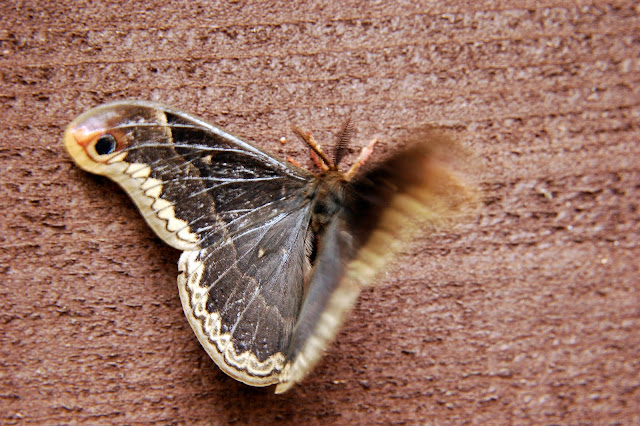
This is a member of the silkmoth family, Saturniidae, and some internet searching the day that we encountered this moth turned up the name Promethea moth, Callosamia promethea. Pretty stunning, right? Well, wait till he opens his wings - the difference is like day, and... night:

Yes, this really is two pictures of the same moth. The males can be told apart from the females by the black coloring of their open wings. The photo is blurry because this guy didn't hold his wings still once he had opened them.


Nina and I were able to snap a few photos of him with open wings before he took off, never to be seen by us again. Interestingly, Jim McCormac found a female Promethea moth hanging out on his cabin, which was maybe 200 yards away from ours. I wouldn't be at all surprised if our male moth paid his female moth a little visit, if you know what I mean. Read more about Jim's encounter with the Promethea HERE.

Having said that my moth ID skills are not very good, I came across something confusing on the Butterflies and Moths of North America website when I was trying to learn more about the Promethea moth: there is a VERY similar-looking moth called the Tuliptree silkmoth, Callosamia angulifera. Being not well-acquainted with these creatures, I never would have been able to call the ID on my own. It seems similar to the novice birder's attempt to distinguish a Downy Woodpecker from a Hairy Woodpecker, or a Cooper's Hawk from a Sharp-shinned Hawk, if you've only seen one and not the other and have no reference on size or habits. To make matters more confusing, both will use Tulip tree (Liriodendron tulipifera) as a host plant for their caterpillars, and there was an abundance of Tulip trees around our cabin.

A tidbit about the silkmoths is that the adults do not feed. They emerge from their cocoon, mate, lay eggs and die, often in a matter of days. When I learned about this a few years ago, it boggled my mind, and it still does. I imagine there has to be a name for this type of life cycle, and I've been scouring the internet for such information, but so far I have come up empty-handed. It's information and questions like these that keep me ever-interested in the complexity of nature.