
As luck would have it, though, we kept the back porch light on at our cabin every night, and we were treated to some very nice moths right outside our back door on the warmer evenings. These were actually all photographed during daylight hours, and I suspect that the afternoon sun that beamed onto the wood siding on the back of the cabin was inviting to them as they warmed up in preparation for evening flight.

Here's a Rosy maple moth, Dryocampa rubicunda. This little show stopper greeted us the day we arrived at the cabin, staying tucked up against the door frame. This was my first encounter with the moth, but Nina had seen this on previous treks to New River and was able to identify it right away. As its common name implies, the host plant for Rosy maple moth caterpillars are maples, such as red maple, sugar maple and silver maple.
My moth ID skills are horrible, so I can't tell you who some of these beauties are (I can't wait until Seabrooke Leckie's new moth guide comes out in 2012!). To anyone out there who is more knowledgeable, I would love to be informed of their identities.


This moth seems like some kind of leaf mimic to me. Wonder what it would have looked like with wings spread out?

This unknown moth looks like it escaped an encounter with a predator based on the chunk missing from its wing.

Here's another one that's looking a little on the tattered side. I saw a number of these on our cabin, and they all liked tucking themselves up under the wood siding.

I really love this one for its coloring. It puts me in the mind of lichen.

This view is even better. The markings on the upper "back" look to me like closed eyes with big false eyelashes on them.
All of these moths so far are on the relatively small side (bodies a couple of inches in length, and most could probably fit on a half dollar piece with wings closed). We were very lucky, however, to see the largest moth of the trip one afternoon later in the week.

This is a member of the silkmoth family, Saturniidae, and some internet searching the day that we encountered this moth turned up the name Promethea moth, Callosamia promethea. Pretty stunning, right? Well, wait till he opens his wings - the difference is like day, and... night:

Yes, this really is two pictures of the same moth. The males can be told apart from the females by the black coloring of their open wings. The photo is blurry because this guy didn't hold his wings still once he had opened them.
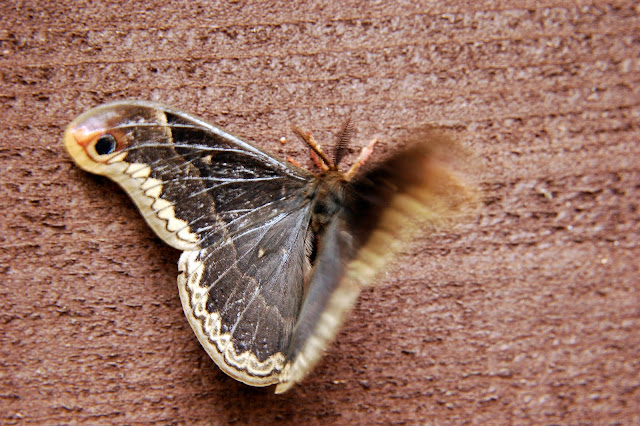
Nina and I were able to snap a few photos of him with open wings before he took off, never to be seen by us again. Interestingly, Jim McCormac found a female Promethea moth hanging out on his cabin, which was maybe 200 yards away from ours. I wouldn't be at all surprised if our male moth paid his female moth a little visit, if you know what I mean. Read more about Jim's encounter with the Promethea HERE.
Having said that my moth ID skills are not very good, I came across something confusing on the Butterflies and Moths of North America website when I was trying to learn more about the Promethea moth: there is a VERY similar-looking moth called the Tuliptree silkmoth, Callosamia angulifera. Being not well-acquainted with these creatures, I never would have been able to call the ID on my own. It seems similar to the novice birder's attempt to distinguish a Downy Woodpecker from a Hairy Woodpecker, or a Cooper's Hawk from a Sharp-shinned Hawk, if you've only seen one and not the other and have no reference on size or habits. To make matters more confusing, both will use Tulip tree (Liriodendron tulipifera) as a host plant for their caterpillars, and there was an abundance of Tulip trees around our cabin.
A tidbit about the silkmoths is that the adults do not feed. They emerge from their cocoon, mate, lay eggs and die, often in a matter of days. When I learned about this a few years ago, it boggled my mind, and it still does. I imagine there has to be a name for this type of life cycle, and I've been scouring the internet for such information, but so far I have come up empty-handed. It's information and questions like these that keep me ever-interested in the complexity of nature.


