


White-breasted Nuthatch and Red-bellied Woodpecker enjoying tasty treats during past FeederWatch seasons.
This will be my fifth year of participating in Project FeederWatch (PFW, for short), and I feel an obligation to my fellow birders to tell them about this cool citizen science program. Here's a description of FeederWatch from Cornell's site:
Project FeederWatch is a winter-long survey of birds that visit feeders at backyards, nature centers, community areas, and other locales in North America. FeederWatchers periodically count the birds they see at their feeders from November through early April and send their counts to Project FeederWatch. FeederWatch data help scientists track broadscale movements of winter bird populations and long-term trends in bird distribution and abundance.

How did I figure out how to keep Downy and Hairy straight in my mind? "D"owny is "d"ainty and "H"airy is "h"uge!
There are lots of great reasons to participate in Project FeederWatch. For one thing, it gives you an "excuse" to spend lots of time watching your feathered backyard friends. If anyone in your household accuses you of spending too much time looking at the backyard birds, tell them, "It's for science!"
It's also a very good way to learn and get a better understanding of bird behavior and "mannerisms." Some birds are more aggresive than others, some may be more tolerant of you during feeder filling, etc.
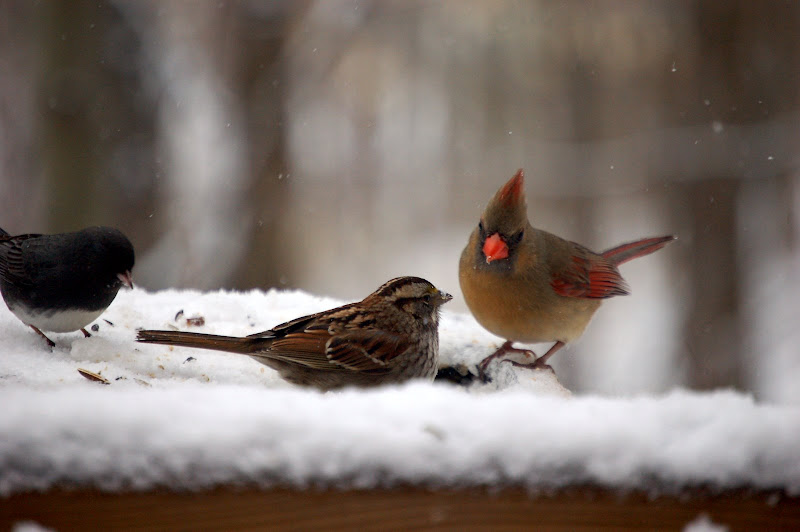


Tempers can subside as quickly as they flare.
Don't know for sure which birds are ground feeders or who prefers which feeder? You'll learn this very quickly by participating in PFW.

Male Dark-eyed Junco (slate-colored race), a predominantly ground-feeding species.
Another benefit of participating over time is watching trends develop. Every year the folks at Cornell put together summaries of the data they received from all over the country, but you can also observe the trends right in your own yard. Once you have entered data for a count session, you will be able to look at it whenever you like. The Lab keeps all of your count data available online from every year that you participate, and you can sort by species, by average group size, or by group size on a specific date.
After 4 seasons of counting I can now make observations about the population trends of the birds that visit our feeders.
For example, last year was a terribly light year for Carolina Wrens at our feeders. I only counted 1 Carolina Wren for the entire 21 weeks of the season. I have high hopes for a rebound in their numbers this year. I have noticed a much stronger presence of them so far this fall, and I have seen them around regularly for quite a few weeks now. We shall see.
Also, we are about due for a visit from the Red-breasted Nuthatches. They have been present every other year, and they weren't here last year, so I'm keeping my fingers crossed that the pattern will continue and that they will show up this year. Haven't seen any yet, but there's still time!
Also worth mentioning: the American Goldfinch was the most populous bird at our feeders the first year I counted, with an average group size of 15.2. Those numbers have fluctuated and dropped since then, though. Average group size in season 2 was 9.0 (ranked 1st); in season 3 it was 10.1 (ranked 2nd after Mourning Dove); in season 4 it dropped to 8.3 (ranked 3rd behind Mourning Dove and Pine Siskin). What will this season bring for our American Goldfinches? (In case anyone is wondering, I've only ever observed one goldfinch with House Finch eye disease (conjunctivitis), so I don't think there is necessarily any disease that has decreased their numbers.)

Mourning Dove with icy tail feathers. MODO's have ranked in the top 3 for average group size at our feeders every count year so far.
If you need any more convincing to get involved with this project, let me tell you that it's a great cure for the winter blahs. Having something specific to focus on, and knowing that this is pretty much a "winter-only" thing, really gives me something to look forward to on the weekends during those cold, dreary months. One of my favorite things to do in winter, actually, is to get bundled up and go hang out on the deck after dinner and count the birds as I "listen in" on their own dinner conversations.
I also encourage anyone who does participate in PFW to submit any cool or interesting photos you might take during the season to the Cornell Lab. They do a pretty good job of showcasing these photos, and they use them on a lot of the promotional materials concerning the program.
So, are you on board? For more information, go to Project FeederWatch (link will open in new window). You can also click on the PFW badge over in the sidebar. You can sign up now if you haven't already, or you can sign up any time during the season, up until the very end of February. I would love to include a list of fellow FeederWatchers over in my sidebar, so if you're interested in having your blog included in that list, just let me know in the comments, or drop me an email, and I'll add you!
Happy birding!

