Showing posts with label Project Feederwatch. Show all posts

Sunday, February 12, 2012

Oh, how I love my birds

In my last post, I mentioned how Carolina Wrens are the apple of my eye as far as species that dine at my feeders in winter go(or any time of year, really). If a weekend of counting for Project FeederWatch goes by with a goose egg on my list next to "CAWR"* (the 4-letter shorthand, known as bander's code or alpha code, for CArolina WRen), it makes me sad. I worry.

This weekend I was sitting at the dining room table having a late breakfast, and I wondered out loud if "my" wrens were okay, because I had not yet heard a peep from them or seen them. Oftentimes they are one of the first birds I hear in the morning, so that was why I was a little concerned. Not to worry, though. As soon I finished posing the question to my bowl of cereal, up popped a wren onto the railing and right into the bowl that holds the bird dough.

It's when things like this happen that I can't help but wonder if there is some kind of connection between myself and the birds. I mean, come on! Wonder about the bird and then it shows up immediately thereafter, as if conjured?!

Don't worry, Heather - we are here and we are fine. Now, if you don't mind, I'm just going to sit in the food.

There were actually 2 of them sitting in here at one point, but I wasn't fast enough with the camera to get a shot of that. In total, there were 3 Carolina Wrens at my feeders at one time this weekend, as was the case last weekend. I had 3 of them at one time in early December, too. This is remarkable because this is the first year in 7 years of counting for FeederWatch that I've ever seen 3 Carolina Wrens at once at my feeders.

Contemplating his/her next bite?

I also enjoy the woodpeckers, and we get three species of them reliably: Downy, Hairy, and Red-bellied. The Downies seem to be the most tame of the three, readily coming in to the suet feeders even if I'm standing right next to them. This sweet little female Downy Woodpecker looks like she just landed, what with the little spray of snow under her tail.

Tra-la-la, minding her own business, making sure I'm getting her good side...

... then this feisty fella shows up. Doesn't he look MAD?! His little head feathers are all puffed up, full of 'tude.

Here's a look at his puffed up mane from the back:

And even though he's chased the female away by now, his bravado continues:

Oh wait, never mind. It's all cool. No problems here, lady.

Lemme jus' grab a big ol' hunk o' dough...
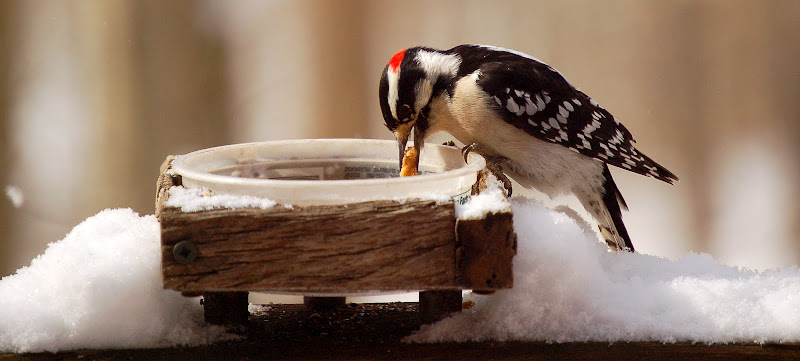
And get on outta here!

I soooo love this shot, caught serendipitously by depressing the shutter at just the right time, of course. It almost has the feel of a raptor caught in flight rather than a woodpecker.

Yes, friends, these are just a few examples of why I love my birds. They are wonderful in every way.

*Okay, regarding the alpha code for Carolina Wren... CAWR isn't technically correct, because that abbreviation could also refer to 2 other wren species in the United States: CActus WRen and CAnyon WRen. The correct bander's code for each of these species is as follows: CACW (Cactus Wren), CARW (Carolina), and CANW (Canyon). I use CAWR for my wren, though, because the chances of me encountering either of the other 2 species, which live out west, is pretty remote at my feeders. Besides, it's shorthand that's supposed to be easy for ME to read. But I digress.

Thursday, December 22, 2011

Dauntless Downy Woodpecker

At our feeders nestled in the woods, 5 species of woodpeckers have been observed dining on suet, and occasionally on sunflower seeds and peanuts. In order of appearance from least to most common, those woodpeckers are: Pileated Woodpecker, Northern Flicker (yellow-shafted form), Red-bellied Woodpecker, Hairy Woodpecker and Downy Woodpecker. On very rare occasions I will see Yellow-bellied Sapsuckers on our property, but they have never come to the feeders.

As you might imagine, the least common visitors get the biggest hoots and hollers from me, and are most likely to find themselves in the cross-hairs of my camera lens. This is unfair to the more common visitors, such as the Hairy and Downy Woodpeckers. As I was looking for photos to illustrate this post, I noticed that I don't have very many photos of Downy Woodpeckers, and the ones that I do have all look virtually the same.


Yup, that's a male Downy Woodpecker clinging to the suet cage. We can tell that it's a male by the little note of red on the back of his head; female Downies have no red on their head.

While I may not jump up and down every time I see a Downy Woodpecker, I certainly do appreciate each appearance they make. They are easily visible year-round, and the parents will bring their begging fledges to our suet feeders once they are old enough to leave the safety of the nest. One time, about 5 years ago, they nested in a snag just above our driveway, and we were alerted to said nest by the incessant begging of the babies within. It took a few days to figure out where this high-pitched squeaking, reminiscent of a mouse with a megaphone, was coming from, and I was happy to learn that it was a clutch of successfully hatched wee Downies.

Since woodpeckers aren't songbirds, we don't really think of them making much noise except for pecking and drumming with their bills on trees or fence posts. They do emit a number of vocalizations, though. Downies make a loud "pick!" sound as well as a whinnying-type of call that descends in pitch at the end. They also make some other squeaky and churring calls, especially when several birds are in close proximity to each other. The Downy population in our woods has slowly been on the rise since I started counting them for Project FeederWatch seven years ago. At first we would only see 1 or 2 Downies at a time, but now it is common to have at least 4 within view at once. I know there are more of them around than that, but keeping them all in sight at one time is tricky! When they are not perched on a feeder, they are in constant motion, hitching up and down the trees in search of bugs in and under the bark, and during the winter it seems like they are constantly bickering, harassing each other, and shooing each other away.


A Downy at the homemade bird dough bowl, watching someone else fly by. Perhaps another Downy?

This year I have noticed an interesting trend among my Downies. Normally when I step outside to refill the feeders, or just to have a look around on the deck, all the birds scatter except for the fearless Carolina Chickadees. Now the Downies are joining the ranks as the next species to be unperturbed by my presence. I can stand right next to the suet feeders with a Downy at arm's length, munching away like it doesn't even see me. Yet another bird whose trust I have presumably earned. I feel mighty honored to stand so close to these fantastic creatures.


Friday, November 18, 2011

Interesting feeder observations

During the Project FeederWatch season I keep a closer eye on what's going on at my feeders, for obvious reasons. When FeederWatch is not in session (i.e. spring, summer and some of fall), however, I don't always pay a lot of attention to the feeders, usually due to a combination of being busy with other outdoor stuff and lack of bird activity at the seed buffet.

A few weeks before this year's FeederWatch season began I did notice a few interesting feeding behaviors.

Interesting behavior #1 - Carolina Chickadees eating thistle seed.

Thistle is widely know as the caviar equivalent for finches of all types. I have never seen thistle listed as a seed that chickadees will go for. If you look at the various charts that show what birds will eat what kind of food at your feeders, you will usually see two listings: one for what is "preferred" and one for what is "readily eaten" (read: tolerated). Thistle doesn't show up as either of those choices for chickadees. And yet, my chickadees really got into it during a period where I wasn't offering sunflower or safflower seeds.


Chickadee-dee-dee clinging on the thistle feeder, and also sharing the feeder with an American Goldfinch.

Once I started offering black-oil sunflower and safflower seed again, I thought for sure they would ditch the thistle, but they proved that theory wrong. They will, of course, partake of sunflower, safflower and suet, but they still also come to the thistle. Anyone else out there ever see their chickadees eat thistle? I know the Juncos will eat it, but only on the ground. A friend once told me that Mourning Doves would routinely eat thistle at his feeders (he had a thistle feeder with perches on it; otherwise, I wouldn't have believed him because there's no way a Mourning Dove could cling to a feeder like the one I have pictured here.)


This proves to me that it's not just one rogue individual who developed a taste for the thistle; at LEAST two of them are fond of it. And look how those toes are clinging to the mesh-like material of the feeder!

Interesting behavior #2 - Northern Cardinals eating suet... from the suet cages.

This one surprised me even more than the chickadees eating thistle seed! Why? Because, typically, cardinals are not birds that cling to things well. Other birds are much more suited to this (especially woodpeckers and nuthatches, but also chickadees, wrens, titmice and finches) simply because of the way their bodies are built and adaptations they have developed over time. How often do you see a cardinal clinging to the side of a tree? Never! Perched on a branch or on the ground is most common, or on a flat feeder like a platform or other type of feeder where they have room to stand. I have seen them attempt (and sometimes succeed) to perch on tube feeders that have those small, 4-inch long perches, but even that is often a tremendous struggle because it's hard for them to keep their balance. So hanging onto a suet cage was beyond my comprehension. (Please excuse the graininess of the following photos - the light was low, so camera settings where cranked up to compensate, making for less than perfect images.)


Cardinal on top of the suet cage? Okay, I can deal with that. I have watched them bend over and peck suet from the top of the cake when it's still new and tall enough to come up to the top of the cage.


Wow, far out! Not only is she exhibiting excellent clinging skills, but great maneuverability as well. Notice how she's making her way down closer to that tiny sliver of suet cake at the bottom of the cage.

As with the chickadees turning to thistle, the cardinals were turning to suet because there was no sunflower or safflower seed available. They continue to repeat this when the seed runs out, but UNLIKE the chickadees, they abandon the suet as soon as seed becomes available again. So the suet is an item of last resort for the cardinals, whereas the thistle got incorporated into the daily diet for the chickadees.

We don't normally see suet "marketed" toward cardinals because most suet is sold in cakes or plugs and offered in feeders that aren't cardinal-friendly. I learned last winter, however, that cardinals DO LIKE suet if it's offered in a way that they can get to it easily. When I make my homemade bird dough, I crumble it into different-sized chunks and scatter it along the deck railing, and also put it in a small dish. They really took to that last year. Knowing this, it makes me wonder if the cardinals that I'm seeing on the suet cages this year are the same cardinals that ate my bird dough last winter, and somehow recognize the suet cakes as something similar, and "oh, hey, this stuff might be good, too, and I'll try my darndest to get to it!"

Suet score!

I would love to hear your stories of odd or interesting feeder behaviors! Feel free to share in the comments.


Monday, November 14, 2011

May the counting begin!

Project FeederWatch got underway this past weekend. This will be my 7th season counting for this citizen science project run by the Cornell Lab of Ornithology, and I can't wait to see what kind of new and interesting things I'll see at my feeders this winter, whether it be a new species, a record-breaking flock of Grackles, or a never before seen behavior or interaction among the birds.

Already I have some interesting data to look at from my first counting session. Looks like things are getting off to a start that is practically identical to last season. The exact same species showed up, with only the tiniest variation in the numbers of each. How about that?

species wknd of 11.13.10 wknd of 11.12.11
Mourning Dove 13 13
Red-bellied Woodpecker 1 1
Downy Woodpecker 2 2
Hairy Woodpecker 1 2
Carolina Chickadee 4 5
Tufted Titmouse 3 2
White-breasted Nuthatch 3 4
Northern Cardinal 2 2
American Goldfinch 9 10
Total individuals 38 41

Looking back on past seasons' data, I should expect to see some Juncos next weekend. I have seen a few in town already, but none yet in our own yard.

I can tell that my fascination with goldfinches and their striking plumage is going to continue.

Here we got a nice look at their white patches above the tail, not feathers you see terribly often

And the nuthatches will continue with their bold antics, running each other off from the feeders. I hope to catch some good shots of them with their various displays of aggression, but they are fast and hard to keep up with the camera. Unless they're eating, that is.

One new bird that I hope to draw in this year is the Brown Creeper. They are definitely in our woods, but they're not exactly a bird that takes to traditional bird feeders. I'm going to try some homemade "bark butter" to see if that will bring them in.

And, it will be time to start making homemade bird dough soon, once the temps actually decide to get cold (as I write this at 8:30 in the evening, it's still 69 degrees outside... I'm not complaining, but it is a bit odd for mid-November!). Will my Pileated Woodpecker come back again this year for a sample of that tasty treat? I surely hope so!

Sunday, January 23, 2011

FeederWatch record smashed

Ahhhh, yet another great weekend of feeder watching has come and gone. There's lots of snow on the ground, and there were lots of birds at the feeders. I was very excited to finally hit a new record for total number of species observed during the 2-day count period. Up until now, 18 species has been the number to beat, but 2 surprise birds on Sunday took it up to 19, and then 20. I've watched the species diversity at our feeders climb slowly year by year, with 15 being the high number during the '05-'06 season, and that figure was reached only once at that. The extra 2 species of woodpeckers this year has certainly contributed to this rise in diversity, and also semi-regular appearances of Common Grackles. I've recorded over 15 species 4 times already this season, and there are still a number of harsh weeks of winter weather yet to go. March usually proves to be a record-setting time, due to a combination of the beginning of spring migration and one last bout of horrible weather conditions. Given that knowledge, I will continue to watch with interest over the next few months as to what may show up.


Species #19, Pine Siskin - I've been waiting for this one to show up for months. I only saw 1 individual, and time will tell if more of them will come visit over the next few days and weeks.


Species #20, Brown-headed Cowbird - a most unusual visitor at our feeders this time of year. They are more common in our yard during spring and summer.

Interestingly, the Cowbird was mixed into a large flock of other blackbirds. Yes, the Common Grackles showed up again. I'm not sure what's going on with these birds this year, but they have been frequenting my feeders, and also my neighbor's feeders about a mile down the road. Whatever the reason may be, I'll take it - they are such stunning birds!

Common Grackle sampling one of my freshly-made suet cakes. Have you figured out yet that I like making food for my birds?


Their dark coloring shows up nicely against the backdrop of beech bark.


Ha! I caught this one mid-scratch.


I was fortunate to get some good shots of both Downy (on the left) and Hairy (on the right) Woodpeckers to use as comparisons between the two. I'll be using these images in my upcoming "Backyard Birding" presentation next week.


How could I pass up sharing a photo of this blazing red beauty? That flaming 'do is like a fiery beacon.


Oh look, another birdie tongue shot! I love it when a shot like this happens.

While we're on the subject of woodpeckers, dare I tell you that there were TWO Pileated Woodpeckers around our feeders this morning? A female and a male. I could hardly contain my excitement. Could this mean that baby Pileateds are in the offing for us? I can only dream...

Sunday, December 19, 2010

Cold weather + snow = good birding!


This weekend was a great birding weekend right in my own back yard, and it made me jump for joy, as this Blue Jay looks like it's doing here.

The cold weather coupled with several inches of snow on the ground brought lots of feathered friends into the feeders. This weekend I counted 128 individual birds, and 18 different species. I was sure 128 must be a record, but it turns out I counted 129 individuals during a freak snow storm in March 2008 (luckily, all my FeederWatch data is stored from year to year). At any rate, I've never had numbers this high in December. Normally, I don't expect to see counts like this until January or February, when we're really into the heart of winter. At this rate, some records could be broken this FeederWatch season. I'm waiting to tip past the 18 species mark, and I think it could happen pretty easily.

The Blue Jays finally made their way back to the feeders for the first time this season. I was so glad to see them. I find them to be beautiful and intriguing. They can be aggressive at the feeders, both toward each other and toward other species, but this weekend they were mild mannered. I think everyone was too busy trying to consume as many calories as they could to worry about wasting them on scuffles.

It took them a little while to get used to the peanut feeder again, but soon the Jays made fast friends with the peanuts.


Oh, and they were big fans of the homemade suet dough I put out. I'll tell you all about that in my next post (the dough, that is)!

An uncommon guest in our yard this weekend was a large flock of Common Grackles. I heard them flying over while I was out this morning, and wondered how they could not be attracted to all the bird activity that was going on here. As it turns out, they were very interested in what was going on.

Two female Grackles, part of a flock of 30+.

I'm used to the typical song birds at my feeders, so having bigger birds like the Blue Jays and Grackles, in addition to a small flock of Eastern Towhees, a Pileated Woodpecker, and a Northern Flicker led me to call this the "Big Bird" weekend.

Other items of note about the weekend:
-A record number of 34 Mourning Doves were counted
-Lots of woodpeckers, with a record of 5 species total for the weekend, and 10 individuals
-Until this weekend, the last time we had a Pileated Woodpecker at the feeders was February 2006 (no photographs, though - sorry!)
-Song Sparrows showed up for the first time this season, and they have arrived at about the same time for the last few years

Like I said, lots of woodpeckers this weekend. Here, we have a female Downy on the left and a female Hairy on the right


Who knows what next weekend will bring? Just like this Blue Jay, I'll be keeping an eye out.

Monday, November 15, 2010

The season of counting has begun!

When I was a young'un, one of my favorite things to do this time of year was leaf through the Service Merchandise catalog (and maybe the JCPenny catalog, too) and look at all the toys that I could ask Santa to bring me for Christmas. I could easily spend hours looking at the same pages over and over, memorizing all the Barbie cars and houses, and cataloging all of the Star Wars action figures that I hadn't collected yet.

Once Christmas was over, though, that was it. I had some new toys to play with, but winter would drag on without much new to look at, and those toy catalogs were gone from my mind by December 26th.

Now, as a grown-up kid, I have a hobby that takes the place of poring over those pages and pages of toys. And it lasts way beyond the holiday season - in fact, it lasts almost until spring! I'm talking about Project FeederWatch, the Cornell Lab or Ornithology citizen science project that got me hooked on birding. This winter marks my 6th season of watching and counting birds and reporting my findings to the Lab. It's so much fun, and it really gives me something to look forward to in the winter. I'm quite prone to the winter "blahs," so having this incentive to look out the window and interact with the natural world is really a wonderful thing.


FeederWatching can be addictive, and may cause you to spend hours watching your feeders. If you're not careful, you might burn a dinner or two because you're otherwise occupied watching the fighting going on between the Pine Siskins and American Goldfinches on the thistle feeder. (Not that I would know anything about birds distracting me from cooking!)


A rare moment when Pine Siskins and American Goldfinches are eating quietly side by side. How many of each bird can you find in this picture?

FeederWatching is easy. Just pick 2 consecutive days out of the week that are convenient for you, and count for as long as you are able. Wait at least 5 days, and then count again for 2 more consecutive days. Lather, rinse and repeat from now until April 8, 2011, reporting your observations to Cornell along the way. My counting schedule is always a 1-2 punch of Saturday and Sunday, simply because those are the 2 days per week when I can spend the greatest number of daylight hours watching my feeders.


This winter I expect to see old friends for sure, and hopefully a few new ones, too. All of our 3 common woodpecker species (Downy, Hairy and Red-bellied) were accounted for this past weekend, and the two common "flocking" species at our feeders (Mourning Dove and American Goldfinch) came out with relatively strong numbers.

The Winter Finch Forecast by Ron Pittaway (hosted on eBird) has given me some idea of specific finch species to look for. One species I could expect to see this winter that I haven't seen before is the Common Redpoll. This would not only be a new feeder bird, but a life bird, as well. According to Pittaway's article, Common Redpolls could "irrupt" (defined as: to increase rapidly and irregularly in number) into the northern U.S. this year for 2 reasons: their food source in northern Canada is scarce this year, and it was an exceptionally good breeding year for the species, with double- and triple-broods reported in parts of Canada, so competition for food will be even greater than usual. I'll be keeping my eyes peeled for this species! BULLETIN: I was just alerted to a map on RareBird.org that is tracking the movements of certain species, such as the Common Redpoll, into Ohio for the 2010-2011 winter season, and they have already been spotted in some of the northern-most counties. (Thanks for the tip, Jim!)

Another finch species of interest is the Purple Finch, which is also expected to be plentiful in the northern U.S. this winter, again because their major food source up north is not in great supply. I don't usually see them until late December or January, if they show up at my feeders at all, but I spotted a male Purple Finch dining on sunflower seeds at my feeder a little over a week ago, which is super early for me. I hope he comes back soon so I can count him for FeederWatch.


I am now confident that I will be seeing Pine Siskins at the feeders this winter.  My first encounter with this species was during the 2008-2009 FeederWatch season, but they were not present during last season's count. Even though Pittaway's article doesn't predict them coming down into the northern U.S. (food sources up north are excellent), I have heard "chatter" suggesting that they are already working their way into Ohio for the season. The above-mentioned map on RareBird.org shows that they are already farther south by this point in November than they were for the entire season in 2009-2010. Apparently they have been spotted in Athens county already.  So riddle me this:  If their food source is abundant up in Canada, what could possibly make them want to come down this way for the winter?  Hmmmmm...


"Hey, Heather says she's got plenty of thistle and black-oil sunflower seeds at her place! Maybe we should go see her!"


"What's that, you say? Party at Heather's? Well, I'll get my sassy little self right on over there!"


So if you are looking for something cool and fun to do this winter, something that will engage you with life right outside your door, consider counting birds and contributing valuable data as a citizen scientist.


This Tufted Titmouse says, "We will stand and be counted!"


Join Project FeederWatch today!

Tuesday, January 12, 2010

Feederwatch, week 9

Okay, everyone say it with me: "Brrrrrrr!" Wow, was it cold this weekend! It got down as low as 1°F right around 8am on Sunday, with a high of 30° sometime Sunday afternoon. We also had about 5" of snow on the ground.

We got a couple of new species at the feeders this weekend, presumably as a result of the snow cover and cold temps. The American Tree Sparrow made its debut showing for this season, and my beloved Eastern Towhee finally made an appearance. Since my first sighting of the Towhee on Sunday I've been seeing them around the neighborhood more frequently. Hooray!

Got lots of photos of various birds eating homemade suet dough this weekend, more of which I'll share in a future post. The Titmice love the stuff, but not all of them were as piggy as this one!


This picture cracks me up - it's as if the Titmouse is claiming the dish and its contents as HIS!


Blue Jay showing me the best view I'm gonna get

My feeder watching will be reduced by a day this coming weekend due to the fact that we'll be spending our daylight hours at the Wilds on Saturday for the Wilds Winter Extravaganza (sponsored by the Ohio Ornithological Society). I look forward to spending time with fellow Ohio birders and hope to add some new birds to the life list (keeping my fingers crossed for a Golden Eagle or a Horned Lark - or both!). And I hope that going some place different will get me out of the funk that has got me down after all of these cold, grey days, despite my best efforts to keep the funk at bay.


Birdy roll call for weekend of 1/9/10-1/19/10
Mourning Dove31
Red-bellied Woodpecker1
Downy Woodpecker2
Blue Jay2
Carolina/Black-capped Chickadee5
Tufted Titmouse5
White-breasted Nuthatch2
Carolina Wren2
Eastern Towhee1
American Tree Sparrow2
Song Sparrow4
White-throated Sparrow4
Dark-eyed Junco4
Northern Cardinal5
American Goldfinch11

Happy birding!

Sunday, January 3, 2010

Feederwatch, week 8

This first weekend of 2010 was a blustery one! The high temperature was 22 degrees, and we had a low of 9 degrees, but a constant light breeze made for an even cooler windchill factor. A light dusting of snow covers the ground, making it easy to see where little birdy feet have hopped about.


It was a good weekend for aiming the camera at my fine-feathered feeder friends from the comfort and warmth of indoors. I got quite a few "take away" shots, like these.


White-breasted Nuthatch and Red-bellied Woodpecker fly off with their respective treats. Once again, you can actually see that red belly.

And the beautiful Northern Cardinal looked especially brilliant.


Kelly, this one's for you!

A very special treat was an extended visit from a sweet Carolina Wren, but I'm saving those photos for another post.

Someone recently asked me if we had noticed an increase in Titmice at the feeders this season, to which I replied "no." Well, I went back and checked data from all seasons to-date, and it turns out that so far this season has seen the greatest average number of Titmice: 4.5. My first season of Feederwatching ('05-'06) saw the lowest average number of Titmice, at 2.4, and last season was the 2nd lowest average with 2.9. Hmmm... last season saw a poor showing for Carolina Wrens, too. I think I need to figure out how to get my data into some kind of chart form for easier analysis, which might help me get a better picture of what happened last winter that made it so difficult for the birds. Now that I think about it, though, the winter may not have had so much to do with at as the summer - maybe last summer was a bad/unsuccessful mating season for some reason.

Anyway, to this weekend's numbers...

Week 8 roll call, 1/2/10-1/3/10:
Mourning Dove25
Red-bellied Woodpecker1
Downy Woodpecker1
Hairy Woodpecker1
Blue Jay1
Carolina/Black-capped Chickadee4
Tufted Titmouse5
White-breasted Nuthatch2
Carolina Wren2
Song Sparrow2
White-throated Sparrow3
Dark-eyed Junco3
Northern Cardinal5
American Goldfinch7

Happy birding!