Showing posts with label bird feeding. Show all posts

Thursday, December 22, 2011

Dauntless Downy Woodpecker

At our feeders nestled in the woods, 5 species of woodpeckers have been observed dining on suet, and occasionally on sunflower seeds and peanuts. In order of appearance from least to most common, those woodpeckers are: Pileated Woodpecker, Northern Flicker (yellow-shafted form), Red-bellied Woodpecker, Hairy Woodpecker and Downy Woodpecker. On very rare occasions I will see Yellow-bellied Sapsuckers on our property, but they have never come to the feeders.

As you might imagine, the least common visitors get the biggest hoots and hollers from me, and are most likely to find themselves in the cross-hairs of my camera lens. This is unfair to the more common visitors, such as the Hairy and Downy Woodpeckers. As I was looking for photos to illustrate this post, I noticed that I don't have very many photos of Downy Woodpeckers, and the ones that I do have all look virtually the same.


Yup, that's a male Downy Woodpecker clinging to the suet cage. We can tell that it's a male by the little note of red on the back of his head; female Downies have no red on their head.

While I may not jump up and down every time I see a Downy Woodpecker, I certainly do appreciate each appearance they make. They are easily visible year-round, and the parents will bring their begging fledges to our suet feeders once they are old enough to leave the safety of the nest. One time, about 5 years ago, they nested in a snag just above our driveway, and we were alerted to said nest by the incessant begging of the babies within. It took a few days to figure out where this high-pitched squeaking, reminiscent of a mouse with a megaphone, was coming from, and I was happy to learn that it was a clutch of successfully hatched wee Downies.

Since woodpeckers aren't songbirds, we don't really think of them making much noise except for pecking and drumming with their bills on trees or fence posts. They do emit a number of vocalizations, though. Downies make a loud "pick!" sound as well as a whinnying-type of call that descends in pitch at the end. They also make some other squeaky and churring calls, especially when several birds are in close proximity to each other. The Downy population in our woods has slowly been on the rise since I started counting them for Project FeederWatch seven years ago. At first we would only see 1 or 2 Downies at a time, but now it is common to have at least 4 within view at once. I know there are more of them around than that, but keeping them all in sight at one time is tricky! When they are not perched on a feeder, they are in constant motion, hitching up and down the trees in search of bugs in and under the bark, and during the winter it seems like they are constantly bickering, harassing each other, and shooing each other away.


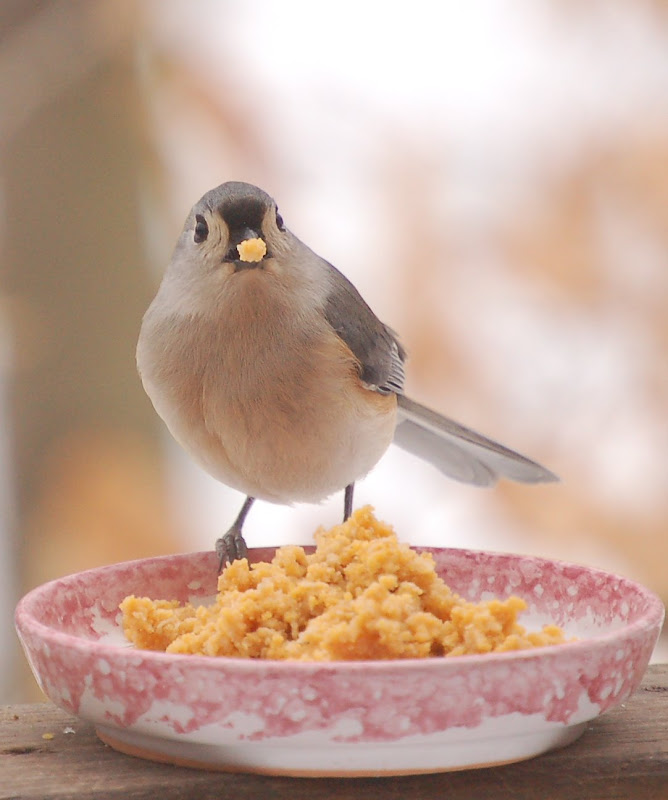
A Downy at the homemade bird dough bowl, watching someone else fly by. Perhaps another Downy?

This year I have noticed an interesting trend among my Downies. Normally when I step outside to refill the feeders, or just to have a look around on the deck, all the birds scatter except for the fearless Carolina Chickadees. Now the Downies are joining the ranks as the next species to be unperturbed by my presence. I can stand right next to the suet feeders with a Downy at arm's length, munching away like it doesn't even see me. Yet another bird whose trust I have presumably earned. I feel mighty honored to stand so close to these fantastic creatures.


Friday, November 18, 2011

Interesting feeder observations

During the Project FeederWatch season I keep a closer eye on what's going on at my feeders, for obvious reasons. When FeederWatch is not in session (i.e. spring, summer and some of fall), however, I don't always pay a lot of attention to the feeders, usually due to a combination of being busy with other outdoor stuff and lack of bird activity at the seed buffet.

A few weeks before this year's FeederWatch season began I did notice a few interesting feeding behaviors.

Interesting behavior #1 - Carolina Chickadees eating thistle seed.

Thistle is widely know as the caviar equivalent for finches of all types. I have never seen thistle listed as a seed that chickadees will go for. If you look at the various charts that show what birds will eat what kind of food at your feeders, you will usually see two listings: one for what is "preferred" and one for what is "readily eaten" (read: tolerated). Thistle doesn't show up as either of those choices for chickadees. And yet, my chickadees really got into it during a period where I wasn't offering sunflower or safflower seeds.


Chickadee-dee-dee clinging on the thistle feeder, and also sharing the feeder with an American Goldfinch.

Once I started offering black-oil sunflower and safflower seed again, I thought for sure they would ditch the thistle, but they proved that theory wrong. They will, of course, partake of sunflower, safflower and suet, but they still also come to the thistle. Anyone else out there ever see their chickadees eat thistle? I know the Juncos will eat it, but only on the ground. A friend once told me that Mourning Doves would routinely eat thistle at his feeders (he had a thistle feeder with perches on it; otherwise, I wouldn't have believed him because there's no way a Mourning Dove could cling to a feeder like the one I have pictured here.)


This proves to me that it's not just one rogue individual who developed a taste for the thistle; at LEAST two of them are fond of it. And look how those toes are clinging to the mesh-like material of the feeder!

Interesting behavior #2 - Northern Cardinals eating suet... from the suet cages.

This one surprised me even more than the chickadees eating thistle seed! Why? Because, typically, cardinals are not birds that cling to things well. Other birds are much more suited to this (especially woodpeckers and nuthatches, but also chickadees, wrens, titmice and finches) simply because of the way their bodies are built and adaptations they have developed over time. How often do you see a cardinal clinging to the side of a tree? Never! Perched on a branch or on the ground is most common, or on a flat feeder like a platform or other type of feeder where they have room to stand. I have seen them attempt (and sometimes succeed) to perch on tube feeders that have those small, 4-inch long perches, but even that is often a tremendous struggle because it's hard for them to keep their balance. So hanging onto a suet cage was beyond my comprehension. (Please excuse the graininess of the following photos - the light was low, so camera settings where cranked up to compensate, making for less than perfect images.)


Cardinal on top of the suet cage? Okay, I can deal with that. I have watched them bend over and peck suet from the top of the cake when it's still new and tall enough to come up to the top of the cage.


Wow, far out! Not only is she exhibiting excellent clinging skills, but great maneuverability as well. Notice how she's making her way down closer to that tiny sliver of suet cake at the bottom of the cage.

As with the chickadees turning to thistle, the cardinals were turning to suet because there was no sunflower or safflower seed available. They continue to repeat this when the seed runs out, but UNLIKE the chickadees, they abandon the suet as soon as seed becomes available again. So the suet is an item of last resort for the cardinals, whereas the thistle got incorporated into the daily diet for the chickadees.

We don't normally see suet "marketed" toward cardinals because most suet is sold in cakes or plugs and offered in feeders that aren't cardinal-friendly. I learned last winter, however, that cardinals DO LIKE suet if it's offered in a way that they can get to it easily. When I make my homemade bird dough, I crumble it into different-sized chunks and scatter it along the deck railing, and also put it in a small dish. They really took to that last year. Knowing this, it makes me wonder if the cardinals that I'm seeing on the suet cages this year are the same cardinals that ate my bird dough last winter, and somehow recognize the suet cakes as something similar, and "oh, hey, this stuff might be good, too, and I'll try my darndest to get to it!"

Suet score!

I would love to hear your stories of odd or interesting feeder behaviors! Feel free to share in the comments.


Wednesday, February 2, 2011

Just can't get enough...

There's that saying "good to last drop." Well, apparently bird dough is good to the last crumb. When the bowl is empty, some of my birdies will resort to trying to lap up any crumbs that might have gotten UNDER the bowl.

The Downies definitely exhibit this behavior.


Carolina Wren, however, wins the prize for "most persistent."


Ehn, ehn!


Got a morsel!


Also wins the prize for "most acrobatic."


Who can resist that little booty sticking up in the air? 'Tocks up!

Sunday, January 9, 2011

Treats for the birds

During my six years of feeding birds in my "yard", things have rarely stayed the same from year to year. We've tried different types of feeders, different configurations of the feeders, and different types of food offered in the feeders. This year, for example, I left behind the "deluxe" seed blend and started offering just straight black-oil sunflower seeds. The cost per pound was only about 10 cents more, so it seemed like a no-brainer. I really think there is much less waste now that the "filler" seeds like millet and milo aren't getting tossed to the ground in favor of the sunflower seeds that they really wanted all along. I don't think there will be any turning back.

Silly me, I had always thought that the Goldfinches were attracted to those tiny filler seeds that I mentioned above, but now I've learned from experience that they love sunflower seeds almost as much as they love nyjer/thistle seed. Here they are lined up to get to the tube feeder that's (half) full of sunflower seeds.

I think of the food that we offer as being in two categories: standard fare, and treats. The standard fare is all of the seed that we offer (sunflower, safflower and nyjer) and suet cakes, while the treats consist of whole raw peanuts in the shell and homemade bird dough. Standard fare is offered to our birds year round, while treats only make an appearance during the winter months. (Let us not forget that there is sugar water offered for the hummingbirds during the summer months, too.)

In regards to the treats, the peanuts are most loved by the Titmice and the Blue Jays. Interestingly, though, the Jays are only interested in the peanuts when there's snow on the ground. Otherwise, the Titmice have the peanuts all to themselves. The occasional White-breasted Nuthatch or Red-bellied Woodpecker will enjoy a peanut every once in a while, too, but not like the Titmice!

The nut's as big as his head!

And then there's the bird dough. Some folks call it Zick dough, due to the fact that Julie Zickefoose helped to make it madly popular through the powers of the internets, but she admits that having the dough named after her makes her feel "a little squeamy." (Julie, is that a cross between "squeamish" and "squirmy"?) To that end, I've just started calling it bird dough. There is a back story to the current iteration of the bird dough recipe, and I really encourage you to read it HERE on Julie's blog. It describes the nutritional rationale behind the recipe, and how it came to be. If this is something you think you would like to make for your birds, please take the time to read Julie's post about it.

So would you like to know the recipe? (Warren and Lisa, I know you've been waiting for this.) Since I make so much of it in the winter, I keep the recipe pinned up to the refrigerator (along with a reminder of the proportions for bleach water for cleaning the feeders!) The recipe goes something like this:

Actually, I've already started to modify the recipe a little from what I have written here, kicking up the peanut butter to 1-1/2 cups and decreasing the lard to 1/2 cup. Also, I've increased the chick starter to 2-1/2 cups, decreasing the cornmeal to 1/2 cup.

The ingredients corralled on the counter. Some assembly required.


This is the new star of the show: chick starter (the unmedicated variety only, please). This helps make the dough a little more nutritious. Available at feed stores (I got mine at Tractor Supply, only $8 for a 20-pound bag).

It's funny how I often think of other types of food as I make up these batches of dough. The chick starter reminds of Grape Nuts cereal (probably has about as much flavor as Grape Nuts, too!), and the dough as it's coming together in the bowl reminds me of no-bake cookie mix (minus the chocolate, of course):

I've taken to buying 40-ounce jars of el-cheapo peanut butter to put in this stuff, and the jars make great holding containers for the finished product. One great thing about this dough: no refrigeration required. I just keep jars of it sitting on the sideboard by our patio door, in close proximity to the feeders.

This stuff really is amazing in that it draws in all KINDS of birds. The only regular birds at our feeders who have shown no interest in it are the Goldfinches. I think it's possible that the dough has helped to boost the woodpecker attendance at our feeders this winter. We had another 5-woodpecker-species weekend this weekend, in fact, and I finally got photos of the Red-bellieds enjoying some dough (I had already gotten photos of the other 4 species at "the dough cup").

Female Red-belly on the left, male on the right


This is the Northern Flicker that fooled no one as my "mystery bird" from a few posts ago.

The dough crumbles nicely, and comes off in both large chunks and in tiny pieces. The large chunks are attractive to Titmice and Blue Jays, both of which love to STUFF THEIR FACES!

Tiny bits are good for tiny birds, like this demure Chickadee.

I don't know what's up with the bird on the left - there's no need to yell like that when someone is eating.

One thing that I really like about the dough is that birds who don't normally get to partake in suet can have a go at this. Examples are Cardinals, Mourning Doves and White-throated Sparrows.

Here's a complete list of the birds who enjoy bird dough at our feeders:
  • Mourning Dove
  • Red-bellied Woodpecker
  • Downy Woodpecker
  • Hairy Woodpecker
  • Pileated Woodpecker
  • Northern Flicker
  • Blue Jay
  • Chickadee
  • Tufted Titmouse
  • White-breasted Nuthatch
  • Carolina Wren
  • White-throated Sparrow
  • Northern Cardinal

Hopefully that list will grow this year to include Juncos and other Sparrows. Hey, I finally got that Pileated to come in, so anything is possible!

Happy Birding, and let me know if you try out the recipe!

Sunday, December 26, 2010

My special Christmas treat

I've been waiting years for this. I've wondered out loud many times, "What do I need to do to draw this bird in to my feeders?" I thought last week's appearance was a fluke not to be repeated. But early on Christmas morning, when the light was still weak, I heard an unmistakable sound. It barged right into the dream I was having and woke me up, encouraging me to peek out the window. Lo and behold, the Pileated had returned. I ran stealthily downstairs to grab the camera. It was a cloudy, gray morning, and I had to turn up settings on the camera to let in as much light as possible, which made for low-quality images, but identifiable images nonetheless, of a female Pileated Woodpecker... at MY feeders!


She's creeping around on the deck railing while I'm creeping around with my camera.


That's a lot of mass to hold up just by your feet!


One of the last images captured on Christmas Day. My Christmas Pileated!

What a treat! I finally got really good looks at her. And she skirted the property throughout the day. Is she here to stay?


Here's the diva as she appeared this morning, the day after Christmas.

I think I'm about to call her a regular. And I think I've figured out what has kept her kind away in the past: the dog. I haven't yet seen her on or around the feeders when the dog is out on the deck. Isn't it funny how such a huge bird, so much larger than most of the other birds who visit the feeders, could be afraid of a dog? She needs to take a lesson in bravery from the Carolina Wren who hops around right under the dog's box that's just outside the patio door - while the dog is in the box!


What's this?! Is there some homemade bird dough in here? Why yes, yes there is.


Is it me, or is she smiling? I was smiling too.

Sunday, December 19, 2010

Cold weather + snow = good birding!


This weekend was a great birding weekend right in my own back yard, and it made me jump for joy, as this Blue Jay looks like it's doing here.

The cold weather coupled with several inches of snow on the ground brought lots of feathered friends into the feeders. This weekend I counted 128 individual birds, and 18 different species. I was sure 128 must be a record, but it turns out I counted 129 individuals during a freak snow storm in March 2008 (luckily, all my FeederWatch data is stored from year to year). At any rate, I've never had numbers this high in December. Normally, I don't expect to see counts like this until January or February, when we're really into the heart of winter. At this rate, some records could be broken this FeederWatch season. I'm waiting to tip past the 18 species mark, and I think it could happen pretty easily.

The Blue Jays finally made their way back to the feeders for the first time this season. I was so glad to see them. I find them to be beautiful and intriguing. They can be aggressive at the feeders, both toward each other and toward other species, but this weekend they were mild mannered. I think everyone was too busy trying to consume as many calories as they could to worry about wasting them on scuffles.

It took them a little while to get used to the peanut feeder again, but soon the Jays made fast friends with the peanuts.


Oh, and they were big fans of the homemade suet dough I put out. I'll tell you all about that in my next post (the dough, that is)!

An uncommon guest in our yard this weekend was a large flock of Common Grackles. I heard them flying over while I was out this morning, and wondered how they could not be attracted to all the bird activity that was going on here. As it turns out, they were very interested in what was going on.

Two female Grackles, part of a flock of 30+.

I'm used to the typical song birds at my feeders, so having bigger birds like the Blue Jays and Grackles, in addition to a small flock of Eastern Towhees, a Pileated Woodpecker, and a Northern Flicker led me to call this the "Big Bird" weekend.

Other items of note about the weekend:
-A record number of 34 Mourning Doves were counted
-Lots of woodpeckers, with a record of 5 species total for the weekend, and 10 individuals
-Until this weekend, the last time we had a Pileated Woodpecker at the feeders was February 2006 (no photographs, though - sorry!)
-Song Sparrows showed up for the first time this season, and they have arrived at about the same time for the last few years

Like I said, lots of woodpeckers this weekend. Here, we have a female Downy on the left and a female Hairy on the right


Who knows what next weekend will bring? Just like this Blue Jay, I'll be keeping an eye out.

Friday, April 30, 2010

Nesting news and videos

Before I head off to Shawnee State Forest for Flora-Quest, I wanted to leave you with some video footage of our Phoebe family. There are 5 healthy (presumably) nestlings, and they are getting bigger every day. Mama and papa Phoebe are super busy from sunup to sundown feeding and removing the waste of these little ones. Here's some video!

In this one, papa brings a bug to mama while she's on the nest, and she gives it to one of the nestlings. They were just a day or two old at this point, and she's sitting right on top of them so you can't see them:

Here's another example of papa helping out with the feeding duties, handing off to mama once again. This is a few days later, and you can see the gaping beaks of the nestlings now:

Finally, here's a clear view of all 5 nestlings during a feeding from one parent. I love how after the adult leaves all of the babies kind of fold back down into the nest synchronously:


In addition to the Phoebe nest, Dave also discovered a Carolina Wren nest under the house a few days ago.  I figured they were nesting somewhere close by, but I couldn't figure out where.

They really aren't picky about where they put their nests:


Can you make out the round opening of the nest over at the right? There are at least 4 little ones in this nest.


So many new flowers are popping open, it's incredible. The wild Geraniums are looking very handsome, and the Firepink is just starting to bloom, as well as Spiderwort. I found a small mass of Blue-eye Mary in the woods across the road last weekend. A life plant for me!


I can't wait to see how many new plants we'll encounter at Flora-Quest this weekend! Keep your fingers crossed that the weather holds for us.

Wednesday, January 13, 2010

Who loves homemade bird food?

My birds do, that's who! This is the second winter I have made homemade suet dough for my feeder friends, and they really went to town on it this weekend. The Tufted Titmice were the biggest customers by far, often waiting in line to take their turn at the little dish in which I offer the dough. For a variety of recipes that you can make at home, visit the Bird Watcher's Digest "Do it yourself" page of recipes. I'm feeding the "bird pudding" recipe to my birds.

Here's some more photos of the locals partaking of the dough.


White-breasted Nuthatch: "Down the hatch!"


Carolina Wren does a face plant right into the dish!


Wow, look at that tongue! Not just for grabbing bugs!


Tufted Titmice eye its prospects...


... and decides that standing ON the food is the best option.


The Titmice really are such clowns!


Other visitors to the dough dish were Red-bellied Woodpecker and Northern Cardinal, but I wasn't able to sneak up on those guys to get their pictures. They see me coming through the window and off they go!